
Your Ultimate Boat Safety Equipment Checklist for 2025

Heading out on the water is one of life's great pleasures, whether you're planning a sunset cruise or a day of unforgettable snorkeling. However, a memorable day can turn dangerous without the right preparation. Many boaters think they have everything they need, only to realize a critical piece of gear is missing when an emergency strikes. This isn't just about ticking boxes for the Coast Guard; it's about safeguarding your passengers, your vessel, and yourself against unexpected situations. Proper preparation is the most critical part of any successful voyage.
This comprehensive boat safety equipment checklist goes beyond the basics, offering actionable insights and practical tips for each essential item. We will break down not just what you need on board, but why you need it and how to use it effectively, ensuring you're prepared for any situation the water throws your way. From personal flotation devices to advanced signaling technology, this guide ensures your focus remains on enjoying the brilliant blue waters of the Florida Keys, not on what you might have forgotten at the dock. This rundown will give you the confidence that you are fully equipped and ready for a safe, enjoyable adventure.
1. Personal Flotation Devices (PFDs)
Personal Flotation Devices, commonly known as PFDs or life jackets, are the single most important piece of gear on any boat safety equipment checklist. These buoyant garments are designed to keep a person's head above water, preventing drowning in an emergency. The U.S. Coast Guard (USCG) legally requires one approved, wearable PFD for each person on board any recreational vessel.
Modern PFDs provide buoyancy through either inherently buoyant closed-cell foam or inflatable chambers that activate manually or automatically. Their effectiveness is undeniable. In a notable 2019 incident on the Lake of the Ozarks, properly worn PFDs were credited with saving all 17 individuals when their vessel capsized in rough waters.
Choosing and Maintaining Your PFDs
Selecting the right PFD is crucial for safety and comfort. An ill-fitting life jacket can be as dangerous as not having one at all. It might slip off or fail to keep your head above water.
- Fit is Paramount: Before buying, try on several PFDs to ensure a snug but comfortable fit. With all straps fastened, have someone lift the PFD by the shoulders. It should not ride up past your chin or ears.
- Check for Approval: Always look for the USCG approval label inside the device. This label confirms it meets federal safety standards and will specify its Type (I-V), which indicates the conditions it's designed for.
- Regular Inspections: Before every outing, check your PFDs for rips, tears, mold, or damaged hardware like broken buckles or rotten straps. Test inflatable PFDs regularly and check their service indicators and CO2 cylinders.
The infographic below highlights the essential specifications to look for in a USCG-approved PFD.
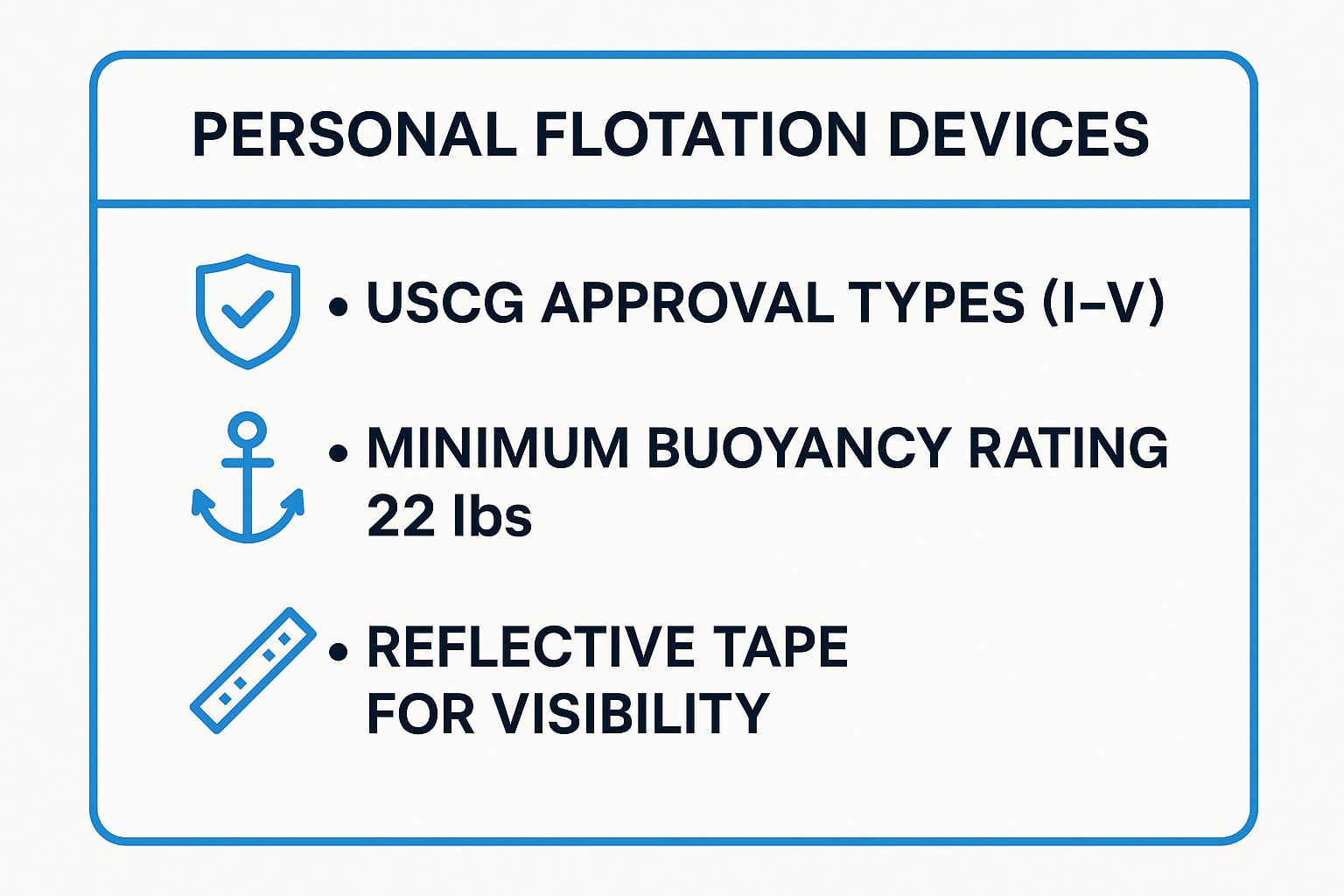
This quick reference shows the key features that ensure a PFD will perform effectively during a rescue, from its certified buoyancy to its visibility in low-light conditions. To help you choose the right gear for personal flotation, consider exploring a guide to the best inflatable life jackets for a deeper dive into modern, comfortable options.
2. Marine VHF Radio
A Marine VHF Radio is a specialized two-way radio transceiver operating on marine frequencies, making it an indispensable communication tool on any boat safety equipment checklist. Unlike a cell phone, a VHF radio allows for broadcast communications to multiple vessels, shore stations, and rescue services simultaneously, without relying on cellular networks that are often unavailable offshore. The U.S. Coast Guard continuously monitors Channel 16, the designated international distress channel, providing a direct line to help in an emergency.
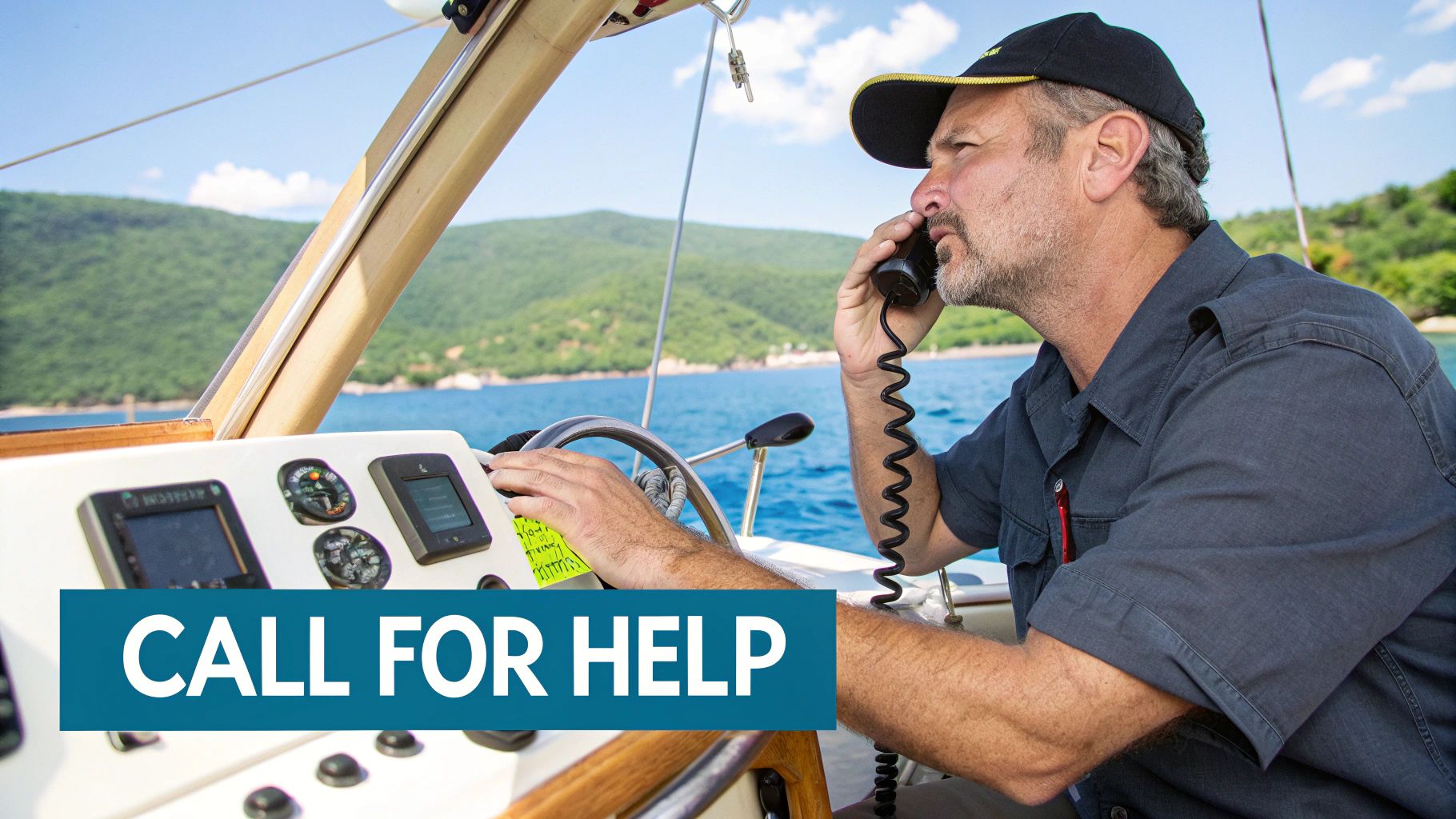
The system's reliability is proven. In 2020, the crew of a distressed fishing vessel off the coast of Alaska used their VHF radio to make a Mayday call on Channel 16, enabling a swift and successful rescue by the Coast Guard. This direct communication channel is crucial for everything from urgent distress calls to receiving vital weather alerts and coordinating with other boaters.
Choosing and Maintaining Your VHF Radio
Selecting a reliable radio and knowing how to use it correctly can be the difference between a minor incident and a major crisis. A powerful, well-maintained VHF radio is your most dependable link to safety.
- Fixed vs. Handheld: Fixed-mount radios offer greater power and range, typically connected to a tall antenna. Handheld radios provide portability, which is useful in a small boat or as a backup in an emergency abandon-ship kit.
- Get Your MMSI: For radios with Digital Selective Calling (DSC), obtain a Maritime Mobile Service Identity (MMSI) number. This unique nine-digit code allows you to send an automated digital distress signal with your boat's identity and location at the push of a button.
- Proper Procedures: Learn the correct procedures for making distress calls ("Mayday"), urgent calls ("Pan-Pan"), and safety calls ("Sécurité"). Conduct regular radio checks on a non-emergency channel, not Channel 16, to ensure your equipment is working.
- Antenna Installation: For fixed-mount units, the antenna's height is more important than the radio's power. Mount your antenna as high as possible to maximize its line-of-sight transmission range.
This reliable communication system is a fundamental component of safe boating practices, ensuring you can call for assistance when you need it most. For those planning on exploring coastal areas, understanding local communication protocols is key; you can discover more about safe on-water practices through a guide on Florida Keys water activities to prepare for your adventures.
3. Emergency Position Indicating Radio Beacon (EPIRB)
An Emergency Position Indicating Radio Beacon (EPIRB) is a critical satellite distress beacon and an essential item on any comprehensive boat safety equipment checklist, especially for offshore voyages. This device is designed to transmit a coded message on the 406 MHz distress frequency, which is relayed via the COSPAS-SARSAT satellite system to search and rescue authorities worldwide. When activated, it provides rescuers with your vessel's unique identification and precise GPS coordinates, enabling a swift response.
The life-saving potential of an EPIRB is well-documented. In 2018, the crew of a sailing vessel was rescued in the vast Pacific Ocean only after their EPIRB activation pinpointed their location for international rescue teams. This technology is a non-negotiable lifeline when you are beyond the range of VHF radio and cell service.
Choosing and Maintaining Your EPIRB
Proper selection and maintenance are vital to ensure your EPIRB functions correctly when you need it most. A malfunctioning beacon is a useless piece of equipment, so diligent upkeep is non-negotiable for anyone venturing into open water.
- Register and Update: Immediately after purchase, you must register your EPIRB with the appropriate national authority, such as NOAA in the United States. Keep your contact and vessel information current, as this data is relayed directly to rescuers.
- Proper Installation: Mount the EPIRB in an easily accessible location where it can be grabbed quickly in an emergency. Consider a Category I, or "float-free," model that automatically deploys and activates if the vessel sinks.
- Routine Checks: Test the unit monthly using its built-in self-test function, which confirms battery power and transmitter operation without sending a false distress signal. Always check the battery's expiration date and replace it as recommended by the manufacturer.
Having a reliable EPIRB is especially important when traveling to remote destinations. Understanding the local conditions is also key to safety, which is why researching the best times to visit the Florida Keys can help you prepare for a safe and enjoyable trip.
4. Fire Extinguishers
A fire on a boat is one of the most dangerous situations a mariner can face, making marine-grade fire extinguishers an absolutely essential part of any boat safety equipment checklist. These specialized devices are designed to combat the types of fires most common on vessels, including those involving fuel (Class B) and electrical systems (Class C). The U.S. Coast Guard (USCG) mandates specific types and numbers of approved extinguishers based on your boat's size and whether it has an inboard engine.
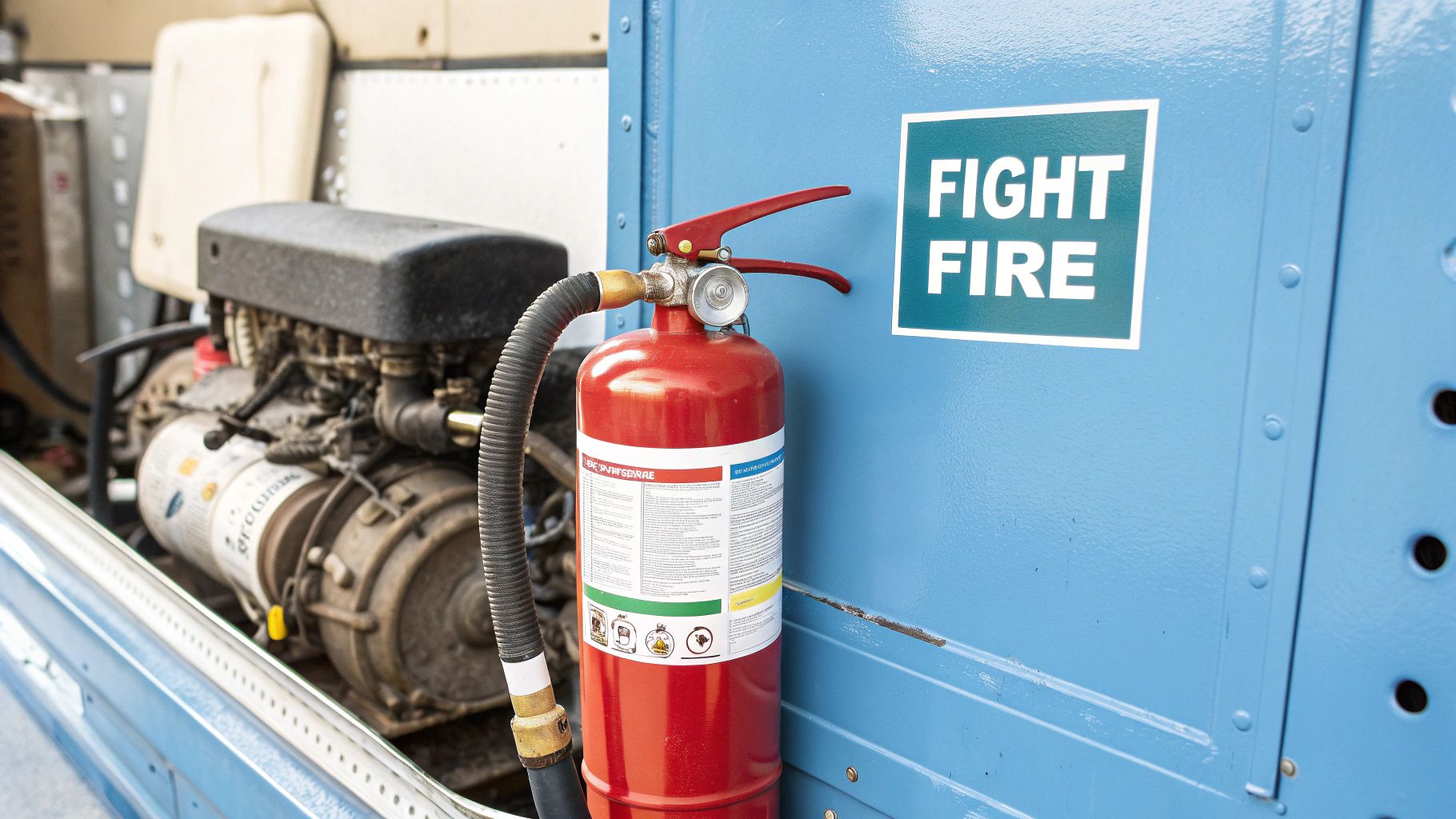
Marine fire extinguishers are crucial because they provide the first line of defense in a confined space where escape routes are limited. Quick action can prevent a small galley flare-up or an engine compartment spark from becoming a catastrophic event. In a well-documented incident at a Florida marina, a boat owner used two B-I extinguishers to suppress an electrical fire that started near the battery compartment, preventing the fire from spreading to adjacent vessels and saving their own boat from total loss.
Using and Maintaining Your Fire Extinguishers
Knowing how to choose, place, and use a fire extinguisher is as important as having one on board. Accessibility and readiness are key to effective fire response on the water.
- Strategic Placement: Mount extinguishers in easily accessible locations, but away from potential fire sources like the engine compartment or galley stove. They should be visible and reachable within seconds.
- Regular Inspections: Check your extinguishers at least once a month. Ensure the pressure gauge is in the green "charged" zone, the pin is in place, and there are no signs of corrosion, dents, or damage.
- Know Your Needs: The number and size of extinguishers required depend on your vessel's length. Boats over 26 feet often need multiple units. Consider an automatic fire suppression system for enclosed engine compartments for an extra layer of protection.
- Learn the PASS Method: All crew and passengers should be familiar with the Pull, Aim, Squeeze, Sweep technique for operating an extinguisher.
The video below offers a practical demonstration on how to correctly use a fire extinguisher in an emergency.
Having the right safety gear and knowing how to use it is fundamental to responsible boating. To ensure you're fully prepared for any adventure, from casual cruising to an exciting Florida Keys snorkeling trip, always start with a thorough safety check.
5. Sound Signaling Devices
Sound signaling devices, such as horns, whistles, and bells, are a critical part of any boat safety equipment checklist. These audible tools are used to communicate with other vessels, especially when visibility is poor, to signal intentions, avoid collisions, and indicate distress. The U.S. Coast Guard (USCG) has specific requirements for sound-producing devices based on vessel length, ensuring that signals are audible enough to be effective over the noise of wind, waves, and engines.
The effectiveness of these devices is proven daily in busy waterways and adverse weather conditions. For instance, during a sudden, dense fog bank in the Florida Keys, a charter boat captain successfully navigated through a narrow channel by using prescribed horn signals, alerting unseen vessels to his position and course, thereby preventing a potential collision. This demonstrates how proper use of sound signals is a fundamental aspect of safe navigation.
Using and Maintaining Your Sound Devices
Choosing and properly using the correct sound signaling device for your boat's size and operating conditions is not just a matter of compliance but of proactive safety. An unreliable horn or a misplaced whistle can leave you silent and vulnerable in a critical moment.
- Know the Rules: Familiarize yourself with the international and inland navigation rules for sound signals. These "rules of the road" dictate specific blast patterns for maneuvering (e.g., one short blast means "I am altering my course to starboard") and for operating in restricted visibility.
- Test Before Each Trip: Always test your primary sound device, such as an electric or air horn, before leaving the dock. This simple check ensures it is functional when you need it most.
- Carry a Backup: Every vessel should have a reliable backup, like a powerful pealess whistle or a handheld air horn. This is especially important in case of electrical failure. Small, portable devices are invaluable in an emergency.
- Check for Approval: Ensure any installed horn or bell meets USCG standards for your vessel's size. The requirements specify the device's audible range (e.g., at least one-half nautical mile for vessels 12 to 20 meters in length).
Effective communication on the water is key to a safe and enjoyable experience, a principle that guided operators of Marathon, Florida boat tours emphasize daily. For more on how professionals ensure safety while exploring the beautiful local waters, you might find it interesting to learn more about their operational standards.
6. Navigation Lights
Navigation lights are an essential component of any boat safety equipment checklist, serving as the universal language of the water after dark and during periods of reduced visibility. These colored lights indicate a vessel's position, heading, and status, allowing other boaters to understand its movements and prevent collisions. The standard configuration includes a red light on the port (left) side, a green light on the starboard (right) side, and a white light at the stern (rear), with potentially another white light at the masthead.
Their role is critical in preventing accidents. In busy channels like those found in the Florida Keys or major harbors, thousands of vessels safely navigate in close proximity by interpreting these light patterns. From commercial freighters to recreational night-fishing boats, navigation lights ensure everyone understands who has the right of way. Proper lighting is not just a recommendation; it is legally required by the U.S. Coast Guard from sunset to sunrise and in conditions like fog or heavy rain.
Operating and Maintaining Your Navigation Lights
Ensuring your navigation lights are functional and used correctly is a fundamental responsibility of any boat operator. Faulty or misused lights can create confusion and lead to dangerous situations, making regular checks and proper operation paramount for safety.
- Know When to Use Them: Always activate your navigation lights from sunset to sunrise. They must also be turned on during any period of restricted visibility, regardless of the time of day.
- Perform Pre-Departure Checks: Before any trip that might extend into the evening, physically switch on your lights and walk around the vessel to confirm every bulb is working.
- Carry Spares and Clean Lenses: For non-LED systems, keeping spare bulbs and fuses on board is a wise precaution. Regularly wipe down the light lenses to remove salt spray and dirt, ensuring they remain bright and visible.
- Understand Light Configurations: Different types of vessels have different lighting requirements. Powerboats, sailboats, and boats at anchor display unique light patterns, so it's crucial to understand what your lights signal to others.
Understanding the rules of the "road" on the water at night is just as important as having the right equipment. To see these principles in action, consider how vessels navigate during a popular activity like a Marathon Sandbar Tour, where boats must safely operate near each other, especially during the beautiful sunset hours. This practical application highlights why reliable navigation lights are a non-negotiable part of your safety gear.
7. First Aid Kit
A marine first aid kit is a crucial component of any boat safety equipment checklist, containing supplies specifically curated for injuries common in a boating environment. Far from a standard household kit, it is designed to manage everything from minor cuts and seasickness to more serious trauma like burns from a galley fire or fishing hook injuries, especially when professional medical help is hours away. Having a comprehensive kit ensures you can provide immediate, effective care in an emergency.
The value of a well-stocked marine kit cannot be overstated. Consider a scenario where a crew member suffers a deep laceration from a fishing hook while miles offshore. A proper marine first aid kit, containing antiseptic wipes, sterile dressings, and trauma pads, allows for immediate wound cleaning and pressure application, preventing infection and controlling bleeding until the boat can reach shore.
Choosing and Maintaining Your First Aid Kit
Selecting and maintaining your first aid kit is vital for ensuring its readiness and effectiveness when an incident occurs. An out-of-date or poorly stocked kit can create a false sense of security and fail you when it's needed most.
- Go Marine-Specific: Purchase a pre-made kit designed specifically for marine use, as it will include items for common boating ailments like seasickness, sunburn, and jellyfish stings. These often come in waterproof containers.
- Customize for Your Crew: Supplement the standard kit with personal items. Include any prescription medications for your crew members, along with specific supplies like an EpiPen for severe allergies or extra motion sickness medication.
- Annual Inspections are Key: At the beginning of each boating season, conduct a thorough inventory. Check the expiration dates on all medications and sterile items, replacing anything that is expired or has been used. Ensure all contents are dry and the container remains waterproof.
Having a solid understanding of first aid is just as important as having the right supplies. Many of the principles for handling minor injuries on a boat are similar to those you'd encounter in other water activities. To broaden your knowledge, explore these fundamental snorkeling safety tips, which cover how to prepare for and respond to common on-water medical situations.
7-Item Boat Safety Equipment Comparison
| Safety Equipment | Implementation Complexity 🔄 | Resource Requirements ⚡ | Expected Outcomes 📊 | Ideal Use Cases 💡 | Key Advantages ⭐ |
|---|---|---|---|---|---|
| Personal Flotation Devices (PFDs) | Low – Easy to wear and use, requires proper sizing | Minimal – Just the device per person plus extras | High – Prevents drowning, legal compliance | Recreational boating, commercial fishing | Legally required, buoyancy support, increased safety confidence |
| Marine VHF Radio | Moderate – Requires programming and antenna installation | Moderate – Radio, power source, antenna | High – Reliable communication and emergency alerts | Navigation, emergency calls, weather updates | Direct Coast Guard contact, no service fees, long-range communication |
| Emergency Position Indicating Radio Beacon (EPIRB) | Moderate – Requires registration, mounting, and periodic testing | Moderate to High – Device cost and maintenance | Very High – Global distress signal with GPS location | Ocean voyages, remote area emergencies | Global satellite coverage, 24/7 monitored, automatic activation |
| Fire Extinguishers | Low – Simple installation and use, requires maintenance | Low to Moderate – Device(s) for boat size | High – Fire suppression, potential vessel loss prevention | All powered boats, engine and galley fire risk | Multi-fire class effectiveness, legally required, quick deployment |
| Sound Signaling Devices | Low – Simple devices but require knowledge of signals | Minimal – Horn/whistle plus mounting | Moderate – Alerts nearby vessels, distress signaling | Navigation in fog/reduced visibility, emergencies | Legally mandated, inexpensive, essential for collision avoidance |
| Navigation Lights | Moderate – Electrical installation and compliance needed | Moderate – Lighting system and power | High – Prevents collisions at night or low visibility | Nighttime navigation, restricted visibility | Legal requirement, LED longevity, clear vessel indication |
| First Aid Kit | Low – Easy to store but requires medical knowledge | Minimal to Moderate – Supplies need regular restocking | High – Immediate injury treatment, emergency care | Extended cruising, injuries onboard | Comprehensive injury management, peace of mind, customizable |
Making Safety Your First Mate on Every Voyage
Navigating the beautiful, clear waters of the Florida Keys is an experience unlike any other, but that freedom comes with a profound responsibility. The items detailed in this comprehensive boat safety equipment checklist are not just regulatory burdens or items to be ticked off a list. They are your first line of defense, your communication lifeline, and your tools for turning a potential crisis into a manageable situation. From the immediate, life-saving accessibility of your Personal Flotation Devices (PFDs) to the long-range assurance of an EPIRB, each piece of gear plays a critical role in a complete safety system.
The core takeaway is that safety is not a passive state; it is an active, ongoing practice. It begins long before you cast off the lines. It involves creating a pre-departure routine where you physically check the charge on your VHF radio, confirm the pressure gauge on your fire extinguishers is in the green, and ensure your first aid kit is fully stocked and its contents are not expired. This proactive mindset is what truly separates a prepared mariner from one who is simply hoping for the best.
From Checklist to Habit
Transforming this list from a document into a deeply ingrained habit is your ultimate goal. To achieve this, consider these actionable steps:
- Create a Physical and Digital Checklist: Laminate a copy of your personalized checklist to keep on the boat. Also, keep a digital version on your phone for easy reference when purchasing supplies or preparing for a trip.
- Schedule Monthly Gear Drills: Don't wait for an emergency to learn how to use your equipment. Once a month, practice deploying a PFD, making a mock call on your VHF radio (without transmitting on channel 16), and locating your sound-signaling devices. Involve your family and frequent guests in these drills.
- Integrate a "Safety Briefing" into Every Outing: Just like on an airplane, take two minutes before leaving the dock to show everyone aboard where the PFDs, fire extinguishers, and first aid kit are located. Appoint a second-in-command who knows how to operate the radio.
By mastering this equipment, you are not just complying with regulations; you are empowering yourself. You are building the confidence to venture further, stay out longer, and handle the unexpected with calm authority. This preparation also extends to broader compliance. Beyond ensuring you have individual safety equipment, understanding and meeting broader regulatory requirements is crucial, such as by obtaining a Boat Safety Certificate where applicable, which formalizes your vessel's adherence to established safety standards.
Ultimately, your commitment to safety becomes the silent "first mate" on every voyage. It’s the peace of mind that allows you to fully immerse yourself in the joy of being on the water, whether you're fishing, diving, or simply cruising into a spectacular Marathon sunset. Make your boat safety equipment checklist a living document, adapt it to your vessel and your adventures, and never leave the dock without it.
Ready to enjoy the stunning waters of Marathon with a crew that puts safety first? Join Marathon Snorkeling And Sunset Cruise for an unforgettable adventure where our lifeguard and CPR-certified crew, along with the lowest passenger-to-crew ratios in the area, ensure your experience is as safe as it is spectacular. Book your next Marathon Snorkeling And Sunset Cruise and let us handle the details while you make memories.