
How to Prevent Motion Sickness: Tips for a Nausea-Free Trip

That queasy, off-balance feeling you get on a boat? It's your brain getting seriously mixed signals. Preventing motion sickness really boils down to one simple idea: you have to reduce the sensory mismatch between what your eyes are seeing and what your inner ear is feeling.
The easiest way to do this is to glue your eyes to a fixed point in the distance, like the horizon. It sounds almost too simple, but that single action helps your brain make sense of the conflicting information that’s making you feel sick.
So, Why Does Motion Sickness Happen on the Water?

That uneasy feeling is your brain’s natural reaction to confusing information. On a boat, your inner ear—the part of your body that controls your balance—is correctly sensing the motion of the waves. It knows you're rocking and swaying.
The problem starts when your eyes tell a different story. Maybe you're looking down at your phone, chatting with a friend across the cabin, or just staring at the boat deck. Your eyes see a stationary environment, but your body feels constant movement.
Your Brain's Internal Alarm System
This disconnect throws your brain for a loop. It interprets the mixed signals as a potential danger—like you've been poisoned—and triggers its defense mechanisms. The result? Those all-too-familiar symptoms:
- Dizziness and feeling lightheaded
- Breaking out in a cold sweat
- That general, hard-to-describe feeling of "wrongness"
- Nausea and, if it gets bad enough, vomiting
The key takeaway here is that motion sickness isn't just a random feeling of being unwell. It's a specific physiological response to a sensory conflict, and the good news is, you can take active steps to manage it.
Of course, other things can make it worse. Choppy seas will amplify the effect tenfold, which is why checking our guide on Florida Keys weather by month can give you a heads-up on what to expect. Even things like where you stand on the boat or what you had for breakfast can play a role in how you feel.
Preparing Before You Leave the Shore

The secret to a seasick-free day on the water often starts long before you ever step foot on the boat. It's all about setting yourself up for success the day before. Trust me, it's a whole lot easier to prevent that queasy feeling from starting than it is to fight it off once you're out on the waves.
Your first line of defense is surprisingly simple: a good night's sleep. Being tired and run down makes you way more susceptible to motion sickness. Do yourself a favor and aim for a full, restful night to make sure your body is ready for the adventure.
Fuel Your Body Wisely
What you eat (and when you eat it) is a game-changer. The night before and the morning of your trip are not the times for a heavy, greasy, or spicy meal. Those kinds of foods can easily upset your stomach, and they’re the last thing you want sloshing around out there.
Instead, think light and bland. Simple stuff like crackers, a banana, or some dry toast are perfect. They're easy to digest and will help settle your stomach without making it work overtime.
Hydration is also a big piece of the puzzle, but don't overdo it right before you board. Gulping down a huge bottle of water just before leaving can leave you feeling bloated and uncomfortable. The better approach is to sip water steadily the day before and the morning of your trip. You'll stay hydrated without feeling like a water balloon.
Research has shown time and again that a little prep work goes a long way. Motion sickness is far easier to prevent than to treat once it kicks in. Studies suggest that avoiding big meals, alcohol, and caffeine—along with certain foods high in histamine like aged cheese or tuna—can make a real difference. If you want to dive deeper, you can read the full research on motion sickness prevention.
Your Pre-Trip Checklist
To keep things straightforward, here are a few key things to do before you head out:
- Rest Up: Seriously, prioritize getting at least 7-8 hours of solid sleep the night before your trip.
- Eat Smart: Have a light meal about 1-2 hours beforehand, not right as you’re walking out the door.
- Pack Accordingly: Toss some bland snacks and a water bottle in your bag. For a complete list, check out our guide on what to bring on a boat trip.
- Choose Your Spot: When you get on the boat, try to find a seat in the middle (midship) and on a lower deck if you can. This spot is the boat's center of gravity, so you'll feel the least amount of rocking and swaying there.
Onboard Strategies to Stay Nausea-Free
Once you're out on the water, your best defense against motion sickness comes down to making small, immediate adjustments. The single most effective trick in the book? Fix your gaze on the stable horizon.
This simple action helps your brain reconcile the motion your inner ear is feeling with a steady visual input, which is exactly what it needs to resolve the sensory conflict that triggers nausea.
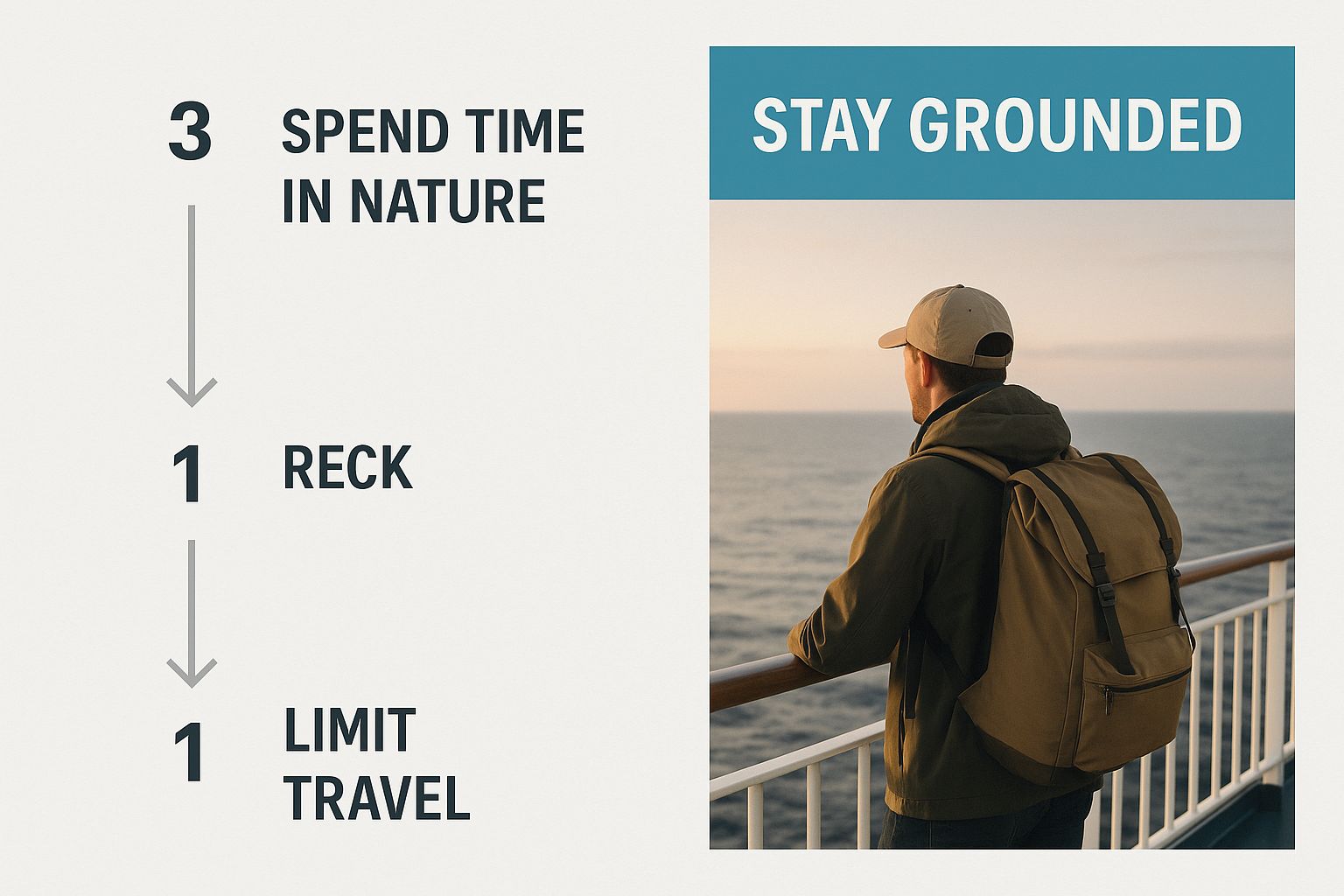
It’s also why looking down at your phone or trying to read a book is often a fast track to feeling queasy. Those activities create an even bigger disconnect, as your eyes focus on a non-moving object while your body sways with the boat. Staring at a fixed point in the distance gives your brain a reliable reference to make sense of the movement.
Mind Your Surroundings
A little fresh air can work wonders for a churning stomach. Trust me, staying on an open deck is almost always better than being cooped up in a stuffy cabin where the air is stagnant. Enclosed spaces can trap odors and amplify the feeling of being disconnected from the boat’s actual movement, making everything worse.
Be especially aware of strong smells, as they can quickly trigger nausea if you're already feeling a bit off.
- Engine Exhaust: Diesel fumes are a classic culprit. Find a spot upwind to avoid them.
- Strong Perfumes: Someone else's fragrance can be surprisingly potent out on the water.
- Food Odors: While snacks are great, the smell of certain foods can be overwhelming if you’re already sensitive.
Sometimes the simplest actions make the biggest difference. Here's a quick rundown of what to do the moment you feel that first hint of queasiness.
Effective On-the-Water Prevention Techniques
| Technique | Why It Works | When to Use It |
|---|---|---|
| Focus on the Horizon | Provides a stable reference point, helping your brain sync visual cues with inner-ear sensations. | The moment you step on the boat, and especially if you start feeling uneasy. |
| Get Fresh Air | Improves circulation and helps dissipate nausea-inducing odors. | Immediately. Move to an open-air deck away from fumes or strong smells. |
| Avoid Reading or Screens | Prevents sensory mismatch between what your eyes see (a still object) and what your body feels (motion). | For the entire duration of the trip. Save the book for the beach. |
| Control Your Breathing | Slow, deep breaths can calm the nervous system and ward off the physical symptoms of anxiety and nausea. | When you feel the first signs of discomfort or anxiety. |
Managing your immediate environment by finding fresh air and avoiding potent smells are crucial in-the-moment adjustments.
Control What You Can
Beyond where you look and stand, you have control over your own body’s response. Conscious, controlled breathing can calm your nervous system and help stave off the physical symptoms of motion sickness. Inhale slowly through your nose, hold for a count, and exhale gently through your mouth.
Good posture helps, too. Sit or stand upright and try to keep your head steady, moving with the boat as much as possible rather than resisting the motion. These little techniques are all part of feeling secure on the water. For more advice, you can explore our comprehensive snorkeling safety tips which cover everything you need to stay comfortable and prepared for your adventure.
Choosing the Right Over-the-Counter Solution
When just staring at the horizon isn't cutting it, over-the-counter medications can be a lifesaver. Walking down the pharmacy aisle can feel like a pop quiz you didn't study for, but it’s actually pretty simple once you know what to look for. Most of these options work by telling your brain to ignore the confusing signals coming from your inner ear.
The two big names you'll see are Dimenhydrinate (the classic Dramamine) and Meclizine (Bonine). They're both antihistamines that do a great job at stopping nausea before it starts, but they have one key difference: the drowsiness factor. Dimenhydrinate has a reputation for making people sleepy, which isn’t exactly ideal when you’re about to jump in the water. Meclizine, on the other hand, is usually sold as a "less drowsy" option, making it a go-to for daytime adventures.
Understanding Dosing and Duration
With these pills, timing is everything. You absolutely have to take them before you feel sick—usually 30 to 60 minutes before you even step on the boat. If you wait until you feel that first wave of queasiness, it's already too late.
- Dimenhydrinate (Dramamine): This one gives you about 4-6 hours of protection. It's a solid choice for shorter outings, like a two-hour sunset cruise or a quick snorkeling trip.
- Meclizine (Bonine): Need something that lasts longer? This is your ticket. A single dose can keep you covered for up to 24 hours, making it perfect for those all-day excursions.
There’s another heavy-hitter to consider: the Scopolamine patch. You just stick it behind your ear a few hours before your trip, and you’re good to go. For people with serious motion sickness, this is often the first thing doctors recommend. One patch can last up to 72 hours, so it’s a fantastic "set it and forget it" solution for a multi-day boat trip or a weekend on the water.
Always read the label and be honest with yourself about how drowsiness might affect your day. The last thing you want is to be groggy while trying out new gear. Our guide to the best snorkel gear for beginners can help you get started safely and confidently.
If you want to get into the nitty-gritty, you can explore the science behind specific medications for motion sickness. And never underestimate a quick chat with your local pharmacist—they can give you personalized advice to make sure you pick the perfect option for your trip.
Natural Remedies and Drug-Free Alternatives
If you'd rather skip the pharmacy, you're in luck. Plenty of seasoned boaters and snorkelers swear by drug-free strategies to keep their sea legs steady. These natural methods are surprisingly effective for keeping you comfortable on the water.
One of the oldest tricks in the book is ginger. This powerhouse root is famous for its ability to calm a queasy stomach. It's also super easy to work into your pre-trip routine. You could sip on some ginger tea the morning of your cruise, pack ginger chews to snack on, or take ginger capsules about an hour before you head out.
Harnessing Pressure Points and Aromas
Another go-to technique is acupressure. The idea is simple: applying pressure to specific points on your body can interrupt nausea signals before they ruin your day. For motion sickness, the magic spot is the P6 (or Nei-Kuan) point on your inner wrist.
You'll find it about three finger-widths down from the base of your palm. Applying firm, steady pressure here can work wonders. You can do it yourself or grab a pair of those specialized acupressure wristbands. They’re simple, widely available, and provide consistent relief whether you're on a short sunset cruise or a full day of fishing in Marathon, Florida.
Don't underestimate the power of your nose. Peppermint aromatherapy is a simple but potent tool. A few deep breaths of peppermint essential oil can soothe your stomach and give you a refreshing mental reset when you start to feel off.
For anyone looking to dive deeper into drug-free options, it's worth understanding the science behind it. You can learn more about the theory of essential acupuncture points for nausea relief and see how this ancient practice tackles modern-day motion sickness.
Got Questions About Beating Motion Sickness?
Even after years of being on the water, we know that questions always come up. Getting the right answers ahead of time can be the difference between a fantastic day exploring the reef and one you’d rather forget.
Here are a few of the things we hear most often.
Can I Still Get Sick on a Calm Day?
You bet. While rough seas are the obvious culprit, the gentle, rolling swell of a perfectly calm day can still do a number on sensitive stomachs. Your brain gets just as confused by that slow, constant rocking.
Never assume a flat sea means you’re in the clear. If you know you’re prone to getting queasy, stick to your game plan no matter what the forecast says. It’s always better to be safe than sorry.
Is Motion Sickness Worse on Smaller Boats?
In general, yes. Smaller boats sit on top of the water, so they feel every bit of the rocking, swaying, and bouncing. Larger vessels, like big ferries or cruise ships, are much more stable because they cut through the water, which smooths out the ride considerably.
That’s actually why we run our snorkeling and sunset cruise trips on catamarans. Their dual-hull design provides incredible stability and minimizes that side-to-side rocking motion that so often makes people feel unwell. It just makes for a much more comfortable trip compared to a standard single-hull boat.
What if I Start Feeling Sick Anyway?
The second you feel that first little twinge of nausea, spring into action. Don’t wait for it to get worse—it’s a battle you’re more likely to win if you start early.
- Find the horizon: This is your best friend. Stare at that fixed point where the sky meets the water to help your brain reset.
- Get fresh air: Head to an open spot on the deck where you can feel the breeze on your face.
- Nibble on something bland: Plain crackers or a few pretzels can work wonders to settle a churning stomach.
- Sip cool water: Stay hydrated with small, slow sips.
The key is to not ignore those early warning signs. A little quick action can stop seasickness in its tracks and get you back to enjoying the view.
Ready to enjoy the water on a beautiful, stable catamaran? Marathon Snorkeling And Sunset Cruise offers incredible adventures with a crew that puts your comfort first. Book your unforgettable snorkeling trip or sunset cruise with us today at https://snorkelingmarathon.com.