
What is Coral Reef Bleaching? Understand the Causes & Impact

When you hear the term coral bleaching, it’s easy to picture something dramatic and final, but the reality is a bit more nuanced. In short, it’s what happens when corals get stressed out by their environment—usually by water that’s too warm—and kick out the tiny algae living inside their tissues. These algae aren't just colorful roommates; they're the coral's primary food source.
Losing them causes the coral to turn stark white, but it's not dead. Not yet, anyway. It's just starving and incredibly vulnerable.
What Is Coral Reef Bleaching In Simple Terms?
Let's break it down with an analogy. Picture a coral as a tiny apartment building and living inside are microscopic tenants called zooxanthellae (pronounced zo-zan-THEL-ee). These aren't just any tenants; they’re the lifeblood of the entire building.
This partnership is a perfect example of symbiosis. The coral "landlord" gives the algae a safe place to live and the raw materials needed for photosynthesis. In return, the algae act like a live-in chef, producing up to 90% of the coral's food. This energy is what allows corals to grow, reproduce, and build the incredible underwater cities we know as reefs.
The Landlord and Tenant Analogy
Think of it this way: the coral is the landlord, and the zooxanthellae are the tenants. As long as the ocean conditions are just right, it’s a happy home. The tenants pay their rent with food, and the landlord provides shelter. Plus, these algae are responsible for giving coral its incredible palette of colors, from deep blues and vibrant greens to fiery oranges and reds.
But when the water gets too hot for too long, the coral landlord gets seriously stressed. This stress makes the algae tenants start producing toxins, turning the once-perfect relationship sour. To save itself, the coral does the only thing it can: it evicts its tenants, kicking the zooxanthellae out into the open water.
When a coral bleaches, it is not dead. It is alive but in a severely weakened and starving state. It has expelled the symbiotic algae that provides it with most of its food and all of its color.
The Ghostly Aftermath
Once the colorful algae are gone, you can see right through the coral's transparent tissue to its white calcium carbonate skeleton underneath. This is the ghostly, bone-white appearance we call coral bleaching.
The coral is still alive, but now it has no primary food source and no protection from the sun's rays. It’s essentially starving and exposed. A bleached coral is far more susceptible to disease and, eventually, death. It's a flashing red light, a clear visual warning that a coral reef ecosystem under severe distress.
If the water temperatures return to normal quickly enough, the algae might come back, and the coral can recover. But if the heat persists, these critical underwater habitats may be lost for good.
Coral Health At a Glance
To make this even clearer, here's a simple breakdown of what a healthy coral looks like compared to a bleached one. This little table sums up the key differences at a glance.
| Coral State | Visual Appearance | Algae (Zooxanthellae) Status | Primary Food Source |
|---|---|---|---|
| Healthy | Colorful (brown, green, blue, etc.) | Algae live happily inside coral tissue | Up to 90% from algae photosynthesis |
| Bleached | Stark white or pale | Algae have been expelled | Lost its main food source; now starving |
As you can see, the presence of those tiny algae makes all the difference between a thriving, vibrant underwater city and a ghostly, struggling skeleton.
The Science Behind Why Corals Turn White
To really get what coral bleaching is all about, you have to look at the incredible partnership between corals and the microscopic algae living inside their tissues. These tiny tenants, called zooxanthellae, have a deal with their coral landlords that’s worked for millions of years: the algae get a safe place to live, and in return, they provide the coral with most of its food through photosynthesis.
But this relationship is fragile, and it’s incredibly sensitive to changes in the environment. The number one trigger for a major breakdown? Unusually warm ocean water that sticks around for too long.
When the water gets too hot, it sends the zooxanthellae into a panic. Their photosynthesis process goes into overdrive and starts churning out harmful byproducts—basically, toxins. Suddenly, the tenant that was paying rent with food is now poisoning the landlord.
The coral polyp, facing an internal threat, has only one move left: evict the algae. It's a desperate act of self-preservation. By kicking out its colorful tenants, the coral gets rid of the immediate danger, but it pays a huge price. It loses its primary food source and all of its vibrant color, leaving behind a stark, white skeleton.
The Tipping Point of Ocean Heat
Corals are creatures of habit, thriving in a very narrow temperature range. It doesn't take much to push them over the edge. An increase of just 1-2°C (2-3°F) above the normal summer high is enough to trigger bleaching if it persists for a few weeks. The longer the heat sticks around, the worse the bleaching gets and the slimmer the coral's chances of survival.
This extreme sensitivity is why we see the most devastating bleaching events during record-hot summers. Understanding the typical seasonal temperatures is crucial for recognizing when things are getting dangerous. Our guide on the Florida Keys water temperature gives you a good idea of just how fine that line is.
When sea temperatures remain elevated, the coral's eviction of its algae tenants becomes a desperate, last-ditch effort to survive. The resulting stark white appearance is a clear sign that the reef is in a state of high alert and extreme stress.
More Than Just Hot Water
While rising ocean temperatures are the main culprit behind mass bleaching events, they aren’t working alone. Think of ocean heat as the primary villain, but there are other accomplices that weaken the coral's defenses and make it even more vulnerable to stress.
Sometimes, these other factors can cause localized bleaching on their own, or they can team up with a marine heatwave to make a bad situation even worse. A healthy, resilient reef can bounce back from some stress, but one that's already fighting off pollution is in real trouble.
Here are some of the other major threats that help push corals to the breaking point:
- Pollution from Runoff: When fertilizers, pesticides, and sewage from farms and cities wash into the ocean, they poison the water. These chemicals throw off the delicate balance of the marine environment and directly harm corals, making them far more susceptible to heat.
- Harmful Sunscreens: It sounds crazy, but some of the chemicals in common sunscreens—like oxybenzone and octinoxate—are toxic to corals. They can cause bleaching, damage coral DNA, and mess with reproduction. When thousands of swimmers wear these sunscreens on a reef, the damage really adds up.
- Ocean Acidification: The ocean is like a giant sponge for carbon dioxide, but it's absorbing so much from the atmosphere that its chemistry is changing. As the water becomes more acidic, it gets harder for corals to build their calcium carbonate skeletons. This weakens their structure, leaving them less able to cope with other stressors like heat waves.
The Far-Reaching Consequences of Bleached Reefs
When a coral reef turns white, it's more than just a pretty color fading away. It's a silent, blaring alarm that an entire ecosystem is in deep trouble. The consequences ripple out far beyond the reef itself, setting off a devastating chain reaction that hits marine life, coastal communities, and even the safety of our shorelines.
The most immediate and gut-wrenching impact is the catastrophic loss of biodiversity. There's a reason coral reefs are called the "rainforests of the sea." They support an incredible 25% of all marine species while covering less than 1% of the ocean floor. When corals bleach and die, that vibrant, bustling underwater city essentially becomes a ghost town.
All those countless creatures—fish, crabs, turtles, you name it—lose their homes, their food, and their breeding grounds in one fell swoop. The small fish that hide in the coral's branches are suddenly exposed, becoming easy snacks for predators. The bigger animals that feed on those fish either starve or have to move on. What was once a thriving community collapses into a barren, lifeless landscape.
An Ecological Ghost Town
The complex, branching structures of a healthy reef are the perfect shelter and nursery for an unbelievable variety of life. Think of the parrotfish, sea turtles, and clownfish that depend entirely on this habitat. When the coral architects that build these underwater neighborhoods disappear, their countless residents vanish right along with them.
A bleached reef isn’t just an empty structure; it’s a failure of an entire ecosystem. The loss of coral means the loss of shelter, food, and the very foundation that supports thousands of species, leading to a sharp and often irreversible decline in marine biodiversity.
This ecological disaster has serious consequences for people, too, especially for the coastal towns whose lives and livelihoods are tied to the ocean. The fishing industry is usually the first to feel the sting. As fish populations crash from the loss of their habitat, local fishermen see their catches dry up, threatening their jobs and a vital food source for millions.
Economic and Coastal Devastation
The economic fallout from coral bleaching is massive, hitting both tourism and fisheries hard. The ongoing global bleaching event that started in 2023 has hammered major reef systems, from the Caribbean all the way to Australia's Great Barrier Reef. This widespread bleaching puts jobs at risk and destabilizes economies in places that count on healthy reefs to survive. You can get more insights on this record-breaking bleaching event on earth.org.
Beyond fishing, the tourism industry takes a huge hit. Snorkelers and divers travel the globe and spend billions of dollars to see colorful, vibrant reefs. When those reefs turn into white graveyards, the tourists stop coming. That means tour operators, hotels, and restaurants all face financial ruin.
But the danger reaches even those who never dip a toe in the water. Healthy coral reefs act as natural, living sea walls. Their intricate structures are incredibly effective at breaking up waves, absorbing up to 97% of a wave's energy before it slams into the coast. This protection is absolutely critical for shielding communities from storm surges, flooding, and erosion.
When a reef dies, that natural defense system crumbles, leaving the coastline exposed to the ocean's full fury. Homes, roads, and beaches are suddenly at a much greater risk of being washed away, leading to costly damage and displacing entire communities. The loss of a reef isn't just an environmental tragedy—it's a direct threat to human safety and property. Understanding these wide-ranging impacts is a key part of appreciating the importance of global coral reef conservation efforts and the urgent need to protect these underwater treasures.
A Timeline of Global Bleaching Events
To really wrap your head around coral bleaching, you have to see it as more than just a collection of sad, isolated incidents. What we're witnessing is a clear and frightening global trend that’s picking up speed. Looking back at the major global bleaching crises reveals a pattern, and it’s not a pretty one.
For a long time, bleaching was mostly a local problem. That all changed in 1998 when the first truly global mass bleaching event hit. Spurred on by a monster El Niño, it was an absolute catastrophe for reefs, wiping out an estimated 16% of the world's shallow-water corals. It was the world's first major wake-up call, showing just how fragile these vibrant ecosystems are when the ocean turns up the heat.
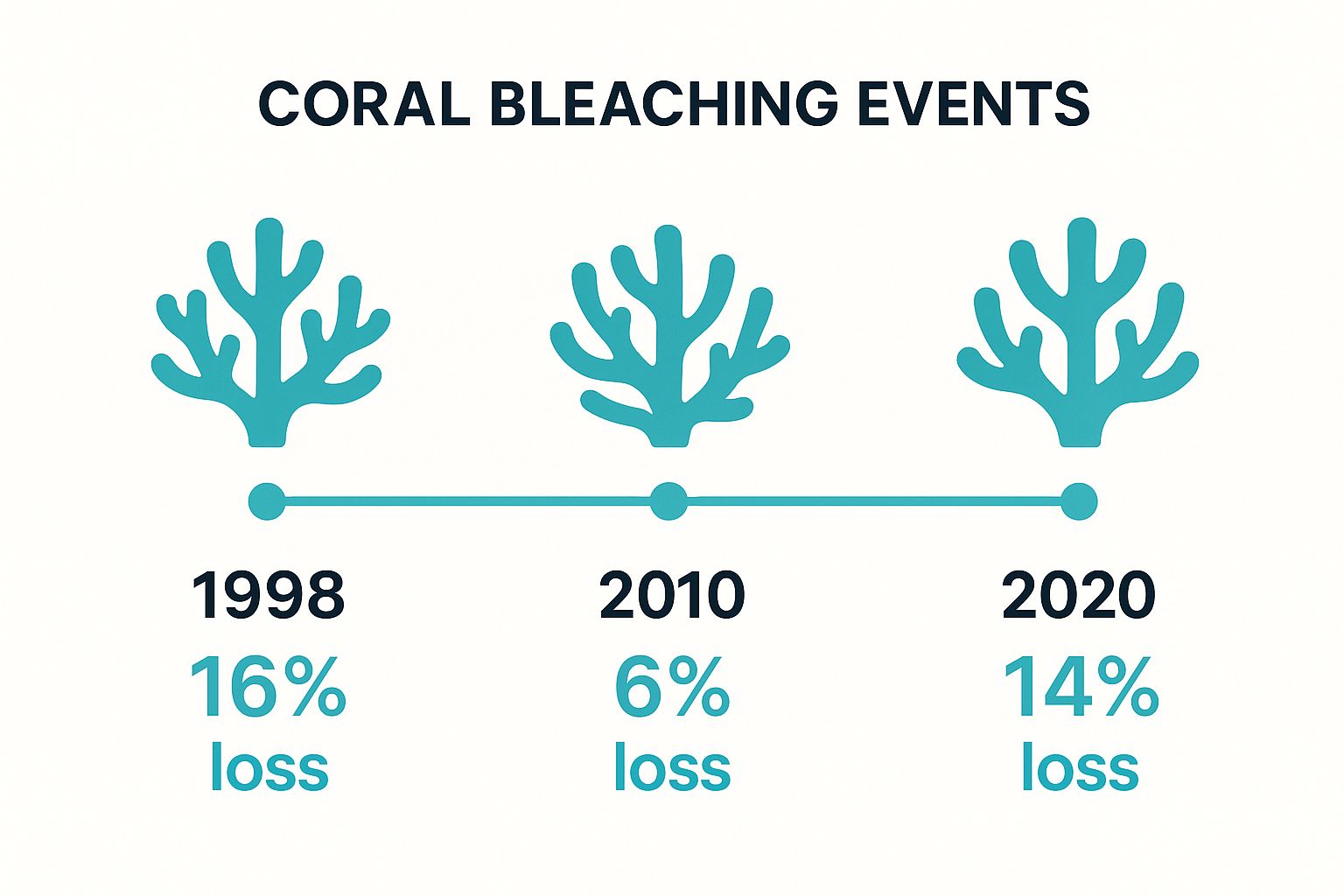
After that, things quieted down for a bit, giving some reefs a chance to catch their breath. But that break didn't last. The second global event struck in 2010, and it was followed by the longest and most destructive bleaching period ever recorded, lasting from 2014 to 2017. This relentless, multi-year crisis pummeled reefs over and over, giving them virtually no time to recover between heatwaves.
The Most Severe Bleaching Event In History
That escalating pattern has brought us to where we are now: in the middle of an environmental disaster. The fourth global bleaching event, which kicked off in February 2023 and is still ongoing, is officially the most widespread in history. It's a devastating blow, impacting an estimated 84% of the world's coral reefs—a massive jump from the 56% affected during the 2014-2017 crisis.
The scale of this is staggering, driven by record-shattering ocean temperatures that have touched reefs in at least 82 different countries and territories. From our backyard in the Florida Keys to the Great Barrier Reef, the damage is immense. This isn't just about losing pretty colors; it’s a direct threat to marine biodiversity and the millions of people in coastal communities who rely on these reefs.
Major Global Coral Bleaching Events
This table paints a pretty stark picture of how these events have become more frequent and more damaging over time.
| Event Period | Key Affected Regions | Estimated Global Reefs Affected |
|---|---|---|
| 1998 | Global, particularly Indian Ocean, Southeast Asia, Western Atlantic | 46% |
| 2010 | Global, with significant impact in Southeast Asia and the Indian Ocean | 35% |
| 2014–2017 | Global, including the Pacific, Atlantic, and Indian Oceans | 56% |
| 2023–2025 | Most widespread on record, affecting all major ocean basins | 84% (and counting) |
What this timeline really shows us is that the recovery window for coral is shrinking—fast. And that’s a huge problem.
No Reef Is Safe From Rising Temperatures
Maybe the scariest part of this whole trend is how little time reefs get to heal. After a major bleaching event, a healthy reef needs at least a decade, sometimes more, to bounce back. But now, with these massive heatwaves hitting every few years, they’re trapped in a cycle of damage with no real chance to recover.
This constant pressure means that even reefs that were once considered tough and resilient are now turning white. It proves this is a truly global issue. While local conservation work is critical, it can’t put up a shield against a marine heatwave. You can get a sense of just how sensitive this balance is by checking out our guide to the typical ocean temperature in Marathon, FL.
This timeline isn’t just history. It's a warning. The science is crystal clear: as long as global temperatures keep climbing, these mass bleaching events will get more frequent and more intense, pushing the world’s most vital underwater cities closer to a point of no return.
How Snorkelers Can Protect Coral Reefs
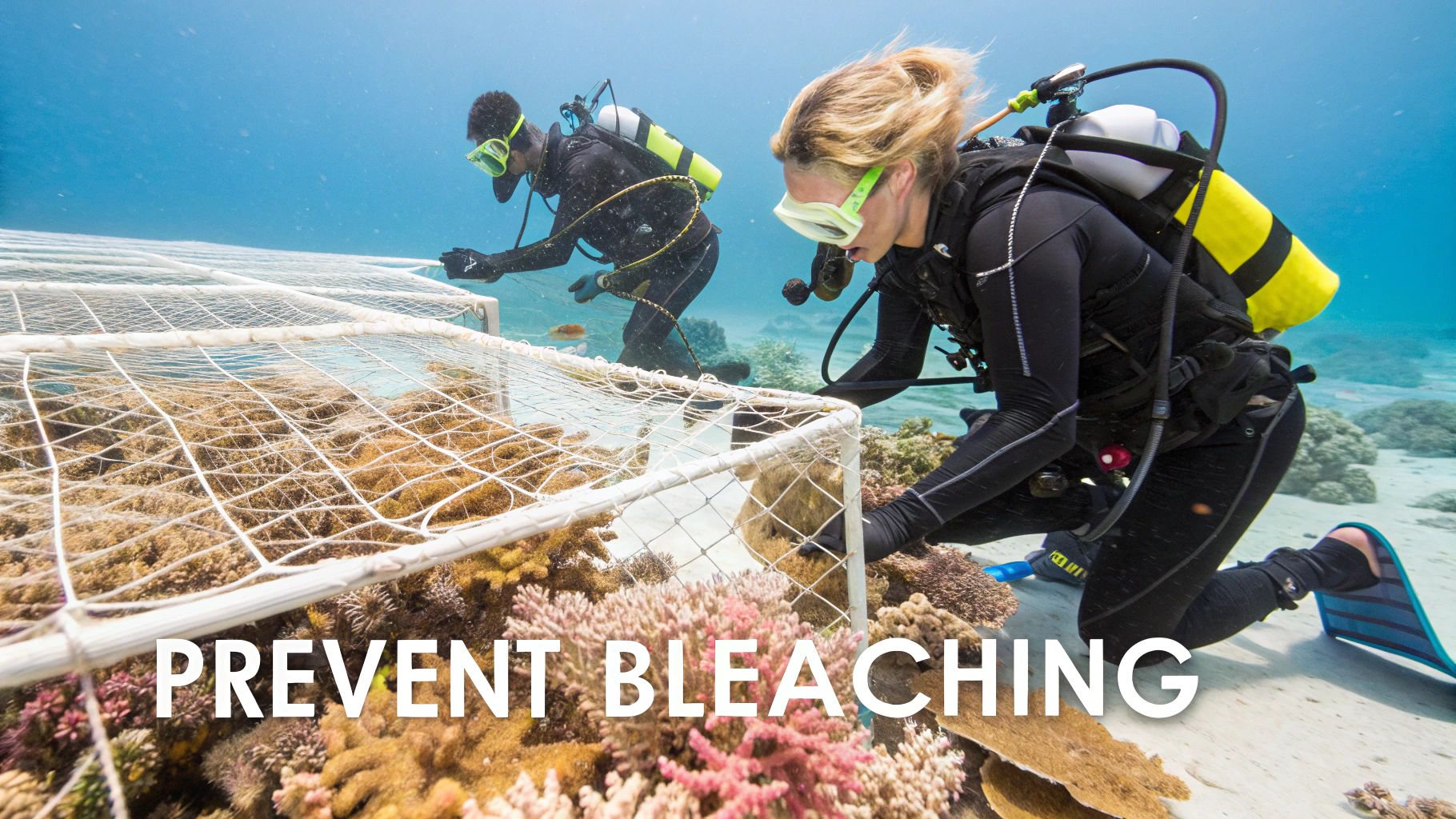
After learning about the causes of coral bleaching and its devastating impact, it’s easy to feel a little helpless. But here’s the thing: as snorkelers and ocean lovers, we're in a unique position to be part of the solution. Every single time you dip your fins into the water, you have a chance to make a positive difference through mindful, responsible actions.
Shifting from a passive observer to an active guardian of the reef doesn't require some massive life change. It all starts with small, conscious decisions. When you multiply those choices by millions of snorkelers around the globe, it creates a powerful force for good. Trust me, your actions in the water matter more than you might think.
Practice Perfect Underwater Etiquette
The most direct way to protect these delicate ecosystems is to master your movements in the water. Corals aren't rocks; they are living animals, and even the slightest touch from a fin, hand, or knee can damage their fragile tissues. This damage leaves them vulnerable to disease and stress, which is why good snorkeling skills are actually a conservation tool.
The golden rule is simple: never touch, stand on, or kick the coral. Always keep a safe distance and be constantly aware of your surroundings, especially your fins. This really comes down to mastering your buoyancy—the ability to float neutrally without sinking or needing to stand up. If you have to adjust your mask or just need a break, find a sandy patch far away from any living reef structures.
Responsible snorkeling is all about leaving no trace. The goal should be to exit the water with the reef in the exact same condition as when you entered, leaving only bubbles behind.
Choose Your Sunscreen Wisely
One of the most important choices you can make happens before you even get in the water: your sunscreen. So many common sunscreens are loaded with chemicals like oxybenzone and octinoxate, which are incredibly toxic to corals. When these chemicals wash off our skin, they can disrupt coral reproduction, damage their DNA, and make them far more susceptible to bleaching.
Switching to a reef-safe sunscreen is one of the easiest and most impactful changes you can make. Just look for mineral-based formulas that use non-nano zinc oxide or titanium dioxide as their active ingredients. To help you sort through the options, our detailed guide explains everything you need to know about what is reef-safe sunscreen and how to choose the right one.
Support and Learn from Responsible Operators
Your choices on land are just as important as your actions in the water. When you're booking a snorkeling trip, actively seek out companies that put conservation and education first. A responsible operator will always:
- Provide a thorough briefing on reef-safe practices before you get in the water.
- Maintain small group sizes to minimize pressure on the reef.
- Use designated mooring buoys instead of dropping destructive anchors that can smash corals to pieces.
On top of that, being an informed snorkeler makes your experience better and helps you protect the environment. To get familiar with the marine life you'll be seeing and learn how to interact responsibly, check out this comprehensive Hawaii reef fish guide for snorkelers. Resources like these empower you to truly appreciate the intricate web of life you're witnessing and understand your role in preserving it for years to come.
Frequently Asked Questions About Coral Bleaching

It’s only natural that learning about coral bleaching brings up more questions. It's a complex topic, after all. Here are some straightforward answers to the questions we hear most often from snorkelers and fellow ocean lovers.
Can A Bleached Coral Reef Actually Recover?
Yes, it absolutely can—but it’s no guarantee. Think of a bleached coral as being alive but starving. If the stressor, like that unusually warm water, goes away quickly enough, the coral can welcome its tiny algae friends back home, regaining its color and its primary food source.
The catch is that recovery is a slow-motion process, often taking years, sometimes even decades, for a reef to get back to its former glory. The real knockout punch comes from repeated bleaching events. When heatwaves hit back-to-back, reefs don't get the breathing room they need to heal, leading to mass die-offs. This is why sustained climate action is so critical.
A single bleaching event is a reef’s cry for help. But repeated events can push it past the point of no return. The shorter that recovery window, the slimmer the chances of a full comeback, which really drives home the urgency of tackling ocean warming at its source.
Is All White Coral Dead?
This is a really common mix-up, and it's an important one. When you see that stark, bone-white coral, you're not looking at a dead coral—you're looking at a bleached coral. The coral animal itself is still alive, but it has kicked out the colorful algae that live inside it, revealing its transparent tissue over its white skeleton. It’s on life support, but there’s still hope.
A truly dead coral looks quite different. Once the coral polyps die, their skeleton gets taken over pretty quickly by a fuzzy, turf-like algae, giving it a dull, often brownish or greenish, smothered look. Knowing how to spot the difference helps you read the story of the reef you’re exploring in real time.
What Is The Most Important Thing I Can Do To Help?
While local efforts are great, the single most powerful thing any of us can do is go after the main culprit behind mass bleaching: global climate change. At its core, coral bleaching is a temperature problem.
This means the best moves we can make are the ones that shrink our carbon footprint. That can be anything from using less energy at home and choosing greener ways to get around to supporting businesses and policies that champion renewable energy. Pushing for strong, climate-forward policies at every level—local, national, and global—is what creates the large-scale change our oceans desperately need.
How Exactly Does Sunscreen Harm Corals?
This is a big one. Certain chemicals found in many common sunscreens are seriously toxic to corals. The two main offenders to watch out for are oxybenzone and octinoxate. When these chemicals wash off our skin in the ocean, they can do a real number on the entire reef ecosystem.
Studies have shown that these chemicals can:
- Mess with a coral's reproduction and growth cycles.
- Damage coral DNA, making it harder for them to bounce back from stress.
- Actually trigger bleaching at lower water temperatures than normal.
Making the switch to mineral-based sunscreens that use non-nano zinc oxide or titanium dioxide is such an easy and effective way to cut out this chemical pollution. It’s a small change for us, but when thousands of visitors do it, it makes a huge difference for the delicate coral communities we're there to see.
Ready to see the vibrant reefs of the Florida Keys and learn more about how to protect them? Snorkeling Marathon And Sunset Cruise offers unforgettable trips guided by a passionate, CPR-certified crew dedicated to ocean conservation. Join us for an adventure you can feel good about.
Book your responsible snorkeling tour today at https://snorkelingmarathon.com