
How to Swim with Fins The Complete Guide

When you learn to swim with fins, the secret is a long, fluid kick that starts from your hips, not your knees. The right technique involves keeping your legs fairly straight and your ankles nice and relaxed. This lets the fin's blade do the heavy lifting, giving you powerful propulsion with surprisingly little effort. It completely changes how you move through the water.
Why Fins Transform Your Time in the Water
Ever wonder what makes fins such a game-changer? It’s not just about speed; they fundamentally alter your entire experience in the water. By making your feet bigger, fins give you a serious power boost, letting you glide much further while using way less energy. For snorkelers checking out a colorful reef or divers exploring a wreck, that efficiency is everything.
And people are catching on. The global market for swimming fins was valued at around USD 93.23 million in 2024 and is expected to climb to approximately USD 130.88 million by 2034. This isn't just a niche trend; it shows a real boom in water sports and fitness, as more people discover just how much fins can improve their speed and cut down on fatigue.
Better Body Position and Strength
One of the biggest perks, especially if you're just starting, is how fins fix bad swimming posture. A classic rookie mistake is letting your legs sink, which creates a ton of drag and slows you right down. Fins provide the lift needed to bring your legs up, helping you achieve a more streamlined, horizontal position in the water. Getting this alignment right is a huge first step, and you can find more great foundational advice in these snorkeling tips for beginners.
Once your body position is sorted, you can really start developing a powerful kick.
Fins naturally encourage you to fire up your core and use the big muscles—your glutes and thighs—instead of just kicking from the calves. This doesn't just make you a stronger swimmer; it builds serious leg power and improves your ankle flexibility over time.
Enhanced Fitness and Exploration
Beyond just technique, fins can seriously ramp up your workout. The extra resistance is fantastic for building muscle and boosting your cardiovascular endurance. It turns what might be a leisurely swim into a genuinely productive fitness session. If you're someone who likes to track your progress, knowing how many calories are burned during swimming can add a little extra motivation.
So, whether you're a fitness swimmer looking to build strength or an adventurer who wants to cover more ground, understanding these benefits is the first step. Fins truly unlock your full potential in the water.
Choosing the Right Fins for Your Adventure
Let’s be honest, not all fins are created equal. The pair that’s perfect for a lazy snorkeling session in the tropics is going to be wildly different from what you’d want for a high-intensity pool workout. Your adventure dictates the gear, and fins are no exception.
The market backs this up, too. The diving segment alone makes up roughly 52.05% of the swimming fins market in 2024. That just goes to show how critical specialized fins are for sports that demand serious underwater power.
Full-Foot vs Open-Heel Fins
One of the first decisions you'll make is whether to go with full-foot or open-heel fins. Each has its place, and the choice is simpler than you might think.
- Full-Foot Fins: Think of these as a water slipper. You slide your bare foot right in. They’re lightweight, a breeze to pack, and absolutely perfect for warm-water snorkeling or a casual swim. No extra gear needed.
- Open-Heel Fins: These have an adjustable strap that goes around your heel. They’re designed to be worn with neoprene booties, which is a game-changer for scuba diving or exploring colder waters. The boots keep your feet warm and offer protection when you're walking over rocks to get into the water.
If you’re just getting started, full-foot fins are usually a fantastic, no-fuss option. For a full rundown on putting together your first kit, our guide on the best snorkel gear for beginners has you covered.
This visual guide is a great shortcut to figuring out which fin type is best for what you have in mind.
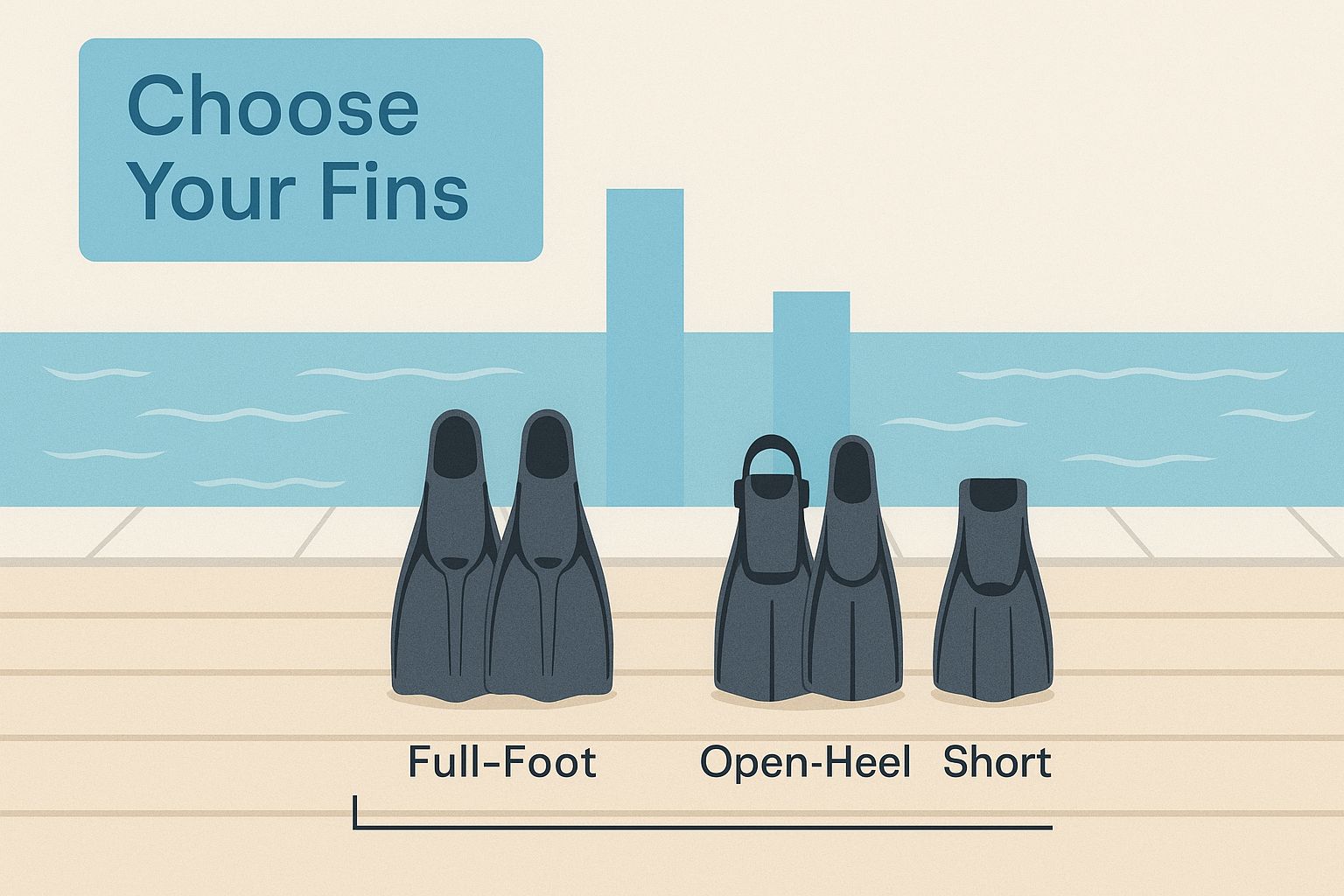
As you can see, what you plan to do in the water is the most important factor, whether it’s a relaxed float or some serious training.
Blade Length and Stiffness Matter
Okay, so you've picked a foot pocket style. Now it's time to think about the engine of the fin: the blade. Its design is everything when it comes to power and efficiency.
For snorkelers, long, flexible blades are your best friend. They give you smooth, powerful propulsion with slow, easy kicks, letting you glide over the reef without startling the fish. On the flip side, short, stiffer blades are the go-to for pool training. They force a faster, more frequent kick, which is incredible for building leg strength and perfecting your technique without taking up half the lane.
The quality of the materials and build is also a huge deal for both performance and how long they'll last. It's worth understanding why quality fins and fin boxes make a difference.
Key Takeaway: The perfect fit is non-negotiable. Your fins should feel snug, but never tight. If they're too loose, you’re in for a world of painful blisters. Too tight, and you'll be dealing with foot cramps that can end your swim before it even gets good. Always try them on if you can, and wiggle your toes—you want a little room, but your heel shouldn't slip out.
Comparing Fin Types for Different Water Activities
To make the choice even clearer, let's break down the main categories of fins and what they excel at. Each type offers a unique balance of power, agility, and comfort depending on its design.
| Fin Type | Best For | Propulsion Power | Maneuverability | Effort Level |
|---|---|---|---|---|
| Long-Blade | Snorkeling, freediving, spearfishing | High | Low | Low to Moderate |
| Short-Blade | Pool training, bodyboarding, bodysurfing | Moderate | High | High |
| Split Fins | Scuba diving, long-distance swimming | High | Moderate | Low |
| Monofins | Competitive freediving, finswimming | Very High | Very Low | High |
Ultimately, this table highlights the trade-offs. A powerful fin might not be the most agile, and a fin designed for training will require more effort. Choose the one that best matches your primary activity, and you'll have a much better time in the water.
Mastering the Fin Kicking Technique
The secret to gliding through the water with power and grace isn't about brute force; it's all about technique. So many beginners make the mistake of thinking the power comes from their feet and ankles. The real engine? Your core.
Effective fin swimming starts from your hips, creating a fluid, whip-like motion that travels all the way down your legs. Think of your legs as extensions of your torso, not separate limbs doing their own thing. When you engage your core and glutes, you initiate a long, powerful kick that lets the fin blade do what it was designed for—propelling you forward with surprising efficiency and very little effort.
The Proper Flutter Kick
To really get the hang of swimming with fins, you need to master the flutter kick. This means keeping your legs relatively straight with just a slight, natural bend at the knee. The motion should feel less like a sharp, jerky kick and more like a gentle, full-leg wave.
Your ankles play a huge role here, but maybe not how you'd expect. Instead of being tense and actively trying to push water, they need to be completely relaxed and flexible. Let them act like hinges, allowing the fin to catch the water and generate thrust on its own. A stiff ankle just fights the water, and you'll get tired fast.
The goal is to let the fin's blade do the heavy lifting. A relaxed ankle allows the blade to flex and snap back, creating a powerful "scoop" of water that pushes you forward effortlessly. Tensing up is the fastest way to waste energy.
Avoiding the Dreaded Bicycle Kick
One of the most common mistakes I see is the "bicycle kick." It’s exactly what it sounds like: pedaling your legs as if you're riding a bike. This motion involves bending your knees way too much, which creates a massive amount of drag.
Instead of moving you forward, this inefficient kick just pushes water downward and forces your body to work much harder. It's a total momentum killer and a surefire way to get leg cramps and feel exhausted. If you feel your knees bending more than just a few degrees, you're probably bicycle kicking.
This becomes especially critical in open water, where you might be dealing with the ocean's natural movement. Understanding a little about what causes ocean currents helps you appreciate why an efficient kick is so important for saving energy on a long snorkel or dive.
Drills to Perfect Your Form
The right technique won't feel natural at first, so building muscle memory is key. Here are a couple of simple but super effective drills you can do in a pool or calm, shallow water.
- Vertical Kicking: Get into water deep enough that you can't touch the bottom. Cross your arms over your chest and tread water using only your legs in an upright position. This drill forces you to engage your core for stability and rely on a powerful, hip-driven kick to stay afloat. Try doing it in 30-second intervals.
- Kickboard Drill: Grab a kickboard, hold it out in front of you, and focus entirely on your lower body. Consciously think about starting each kick from your hips. It helps to watch your fins as you move; you should see the entire blade flexing and bending. This is great for isolating your leg muscles and reinforcing the correct motion.
By practicing these drills, you're training your body to move more efficiently. Pretty soon, that long, powerful flutter kick will become second nature, letting you swim further and faster with way less effort. Every moment in the water will feel more like a graceful glide.
Perfecting Your Body Position and Breathing
People think fins are just for speed, but they do so much more. They’re actually a tool that helps correct your entire position in the water. That extra propulsion creates lift, pushing your hips and legs toward the surface. Suddenly, you’re in a streamlined, horizontal profile that cuts through the water with way less effort.
Your goal is to become a straight line, from the top of your head all the way down to your heels. This is where a little core engagement makes a massive difference. Just by tightening your abs, you stabilize your torso and stop your hips from sagging. It turns your whole body into one efficient swimming machine.
Maintaining a Streamlined Profile
To really get the most out of your fins, you have to nail your head position. Keep it neutral, perfectly aligned with your spine. So many swimmers make the mistake of lifting their head to look forward, but this is like dropping an anchor. It immediately causes your hips and legs to sink, creating a ton of drag.
Instead, get used to looking straight down at the bottom. When you need to check where you're going, take a quick peek and then drop your head right back into that neutral position. It's a simple tweak, but it's one of the most effective ways to reduce resistance and save a ton of energy.
Think of yourself as a torpedo gliding through the water. A straight, rigid body minimizes drag, letting all that power from your fins push you forward. Any break in that line—a lifted head or sinking hips—just wastes precious energy.
Synchronizing Your Breathing with Your Kick
Swimming faster with fins naturally messes with your breathing rhythm. Your body is working harder and demanding more oxygen, so timing your breaths becomes critical if you want to avoid getting winded. The secret is finding a steady, relaxed pattern that syncs up perfectly with your kick.
Don't hold your breath or take panicked gasps of air. It's all about consistency. Try breathing in for two kicks and then breathing out for the next two. This kind of controlled approach keeps your heart rate from spiking and makes sure your muscles get the oxygen they need to keep working.
If you're new to this kind of controlled breathing in the water, our detailed guide on how to breathe when snorkeling breaks it down with tips that work just as well here.
Mastering this synergy between your body position, kick, and breath is what separates an okay swimmer from a great one. It transforms a tiring struggle into a smooth, powerful glide, letting you cover more ground without feeling exhausted.
Taking Care of Your Gear (and Yourself)
Mastering how to swim with fins is one thing, but making sure you and your gear are safe for every adventure is just as important. A little bit of know-how keeps your fins in great shape and, more importantly, keeps you out of trouble.
Some of the most common mishaps are surprisingly simple, like taking a clumsy tumble on your way to the water. I've seen it happen! A golden rule I always follow is to never walk forward with your fins on. Get to the water's edge first, slip them on, and then shuffle backward until you're deep enough to start swimming. It might look a little goofy, but it's a lot better than a face-plant on the sand or rocks.
Don't Forget About Your Body
Beyond keeping your footing, you have to listen to your body. Leg cramps are the nemesis of many fin swimmers, and they often sneak up on you from dehydration or just pushing a little too hard. I always make a point to drink plenty of water before a swim and do a few quick stretches for my calves and hamstrings. It makes a world of difference.
For a complete rundown on staying safe in the water, from checking the local conditions to being aware of your surroundings, our guide on essential snorkeling safety tips is a must-read.
Making Your Fins Last for Years
Proper maintenance is pretty straightforward, but it’s the key to making your investment last. And fins are definitely an investment. It's a growing sport, too—the global market for swimming fins hit around USD 91.18 million in 2024 and is expected to climb to USD 111.37 million by 2030. You can see more on this trend at deepmarketinsights.com. A good pair of fins that you take care of can serve you well for years.
Here's the simple routine I follow to keep my fins in top-notch condition:
- Rinse Them Every Single Time: Salt, chlorine, and sand will absolutely destroy your gear over time. A thorough rinse with fresh water after every single use is non-negotiable.
- Store Them Smart: Never leave your fins baking in the sun. Extreme heat and direct sunlight can warp the plastic and make the rubber brittle. I store mine either flat or hanging by the heel straps in a cool, dry spot.
- Give Them a Quick Once-Over: Before heading out, take 30 seconds to inspect your fins. I'm always looking for tiny cracks, tears, or any signs of wear and tear on the straps and buckles. Catching a small issue early can prevent a big problem in the water.
Following these simple steps does more than just protect your gear; it ensures your fins are safe and reliable every time you hit the water. A well-maintained fin is a trustworthy one.
Got Questions About Swimming with Fins?
Once you get the hang of swimming with fins, a few practical questions almost always pop up. Getting them answered can be the difference between a frustrating swim and a great one. Let's clear up some of the most common things swimmers run into.
People often ask if their long snorkeling fins will work for swimming laps. You technically can, but it's far from ideal. Long fins are built for slow, powerful kicks out in the open ocean, not for a crowded pool lane. They can feel super clumsy and might even be against the rules at your local pool.
For training in a pool, you really want a pair of short-blade fins. They're designed to help you build a faster, more natural kick that strengthens your legs and improves your technique without hammering your joints.
What If My Feet Hurt or I Get Blisters?
Foot pain is another big one. If your feet are getting sore or you’re seeing blisters, it’s almost always a sign that your fins don’t fit right. Fins that are too loose will rub with every single kick, and fins that are too tight will create miserable pressure points.
Fortunately, the fix is pretty straightforward.
- Loose Fins? A pair of thin neoprene fin socks can be a game-changer. They add just enough soft cushioning to fill the gaps and give you a much more secure fit.
- Too Tight? Don't even try to make them work. You just need a bigger size. Forcing your foot into a fin that’s too small is a recipe for pain. It should feel snug like a good shoe, not constricting.
Think of your fins as the engine for your legs. A bad fit turns that engine into an anchor. Take the time to get the sizing right—it’s the single most important thing you can do to stay comfortable in the water.
How Can I Stop Leg Cramps?
There’s nothing worse than being in the middle of a great swim and getting hit with a sudden, sharp leg cramp. It’s pretty common when you first start using fins because you’re working your leg muscles in a totally new and more intense way.
Usually, the culprit is dehydration, fatigue, or just plain bad kicking form. To keep cramps from ruining your swim, make sure you're hydrated before you even get near the water. And always, always ease into your swim to give your muscles a chance to warm up properly.
The biggest thing, though, is to focus on kicking from your hips and thighs, not from your knees and calves. This spreads the work across your biggest muscles, which keeps any one area from getting exhausted. If you do feel a cramp starting, just stop, get to a safe spot, and gently stretch the muscle until it lets go.
Is It Hard to Get Used to Fins?
It definitely feels a little weird at first. Fins add weight and resistance, and they totally change how you move through the water. That initial awkward phase is completely normal, but you'd be surprised how quickly most people get the hang of it.
The secret is just to start slow. Begin in calm, shallow water where you can easily stand up if you need to. Focus on making long, fluid kicks that start from your hips and let the blade of the fin do the heavy lifting. Once you nail the technique, you'll be amazed at how much easier it is to glide through the water. It makes swimming less tiring and a whole lot more fun.
Ready to put these tips into practice on a real Florida Keys reef? Marathon Snorkeling And Sunset Cruise offers incredible trips to Coffins Patch where you can perfect your finning technique among vibrant coral and colorful fish. Join our expert, lifeguard-certified crew for an unforgettable adventure. Book your snorkeling trip today at https://snorkelingmarathon.com.