
What Causes Ocean Currents A Snorkeler’s Guide

Ocean currents are the steady, invisible rivers flowing through the sea, driven by powerful natural forces like wind, temperature, and salt content. Think of them as massive conveyor belts, constantly moving water across the globe and shaping everything from our planet's climate down to the conditions you'll find on your next snorkel trip.
The Invisible Rivers Shaping Your Snorkel Adventure
Ever been snorkeling in the Florida Keys and felt a gentle but persistent push or pull? That’s an ocean current making its presence known. Getting a handle on what drives these currents is the secret to turning a good day on the water into an unforgettable one. These movements aren't just random sloshing; they're part of a massive, predictable system that directly impacts everything you see and feel beneath the surface.
From the mighty Gulf Stream churning offshore to the subtle tidal flows weaving through the patch reefs, these currents are the ocean's lifeblood. They're responsible for transporting nutrients, regulating water temperature, and creating highways for marine life. For us snorkelers, that translates to water clarity, the kinds of creatures we'll encounter, and, most importantly, our safety. Learning to "read" the water starts with understanding what makes it move.
Why Currents Matter For Snorkelers
When you understand the basics of how the ocean circulates, you can start to anticipate the conditions before you even dip your toes in. It elevates your snorkel from just a swim to a true exploration of a living, breathing environment.
- Predicting Conditions: Knowing how wind and tides stir up local currents helps you pick the best times and spots for calm, clear water.
- Enhancing Safety: Being aware of a current's direction and strength is non-negotiable for avoiding fatigue and staying safely within your limits around the reef.
- Spotting Marine Life: Currents are like a free food delivery service for the reef, bringing in plankton and nutrients that attract schools of vibrant fish and other amazing sea creatures.
These unseen forces are absolutely critical to a healthy marine ecosystem, as they shuttle heat and life-giving nutrients around the planet. On the flip side, they can also spread things we don't want. Currents are the main way pollutants travel, which is why understanding things like the hidden dangers of microplastics is so crucial for protecting these beautiful underwater worlds we love to explore.
How Wind Sets the Ocean in Motion
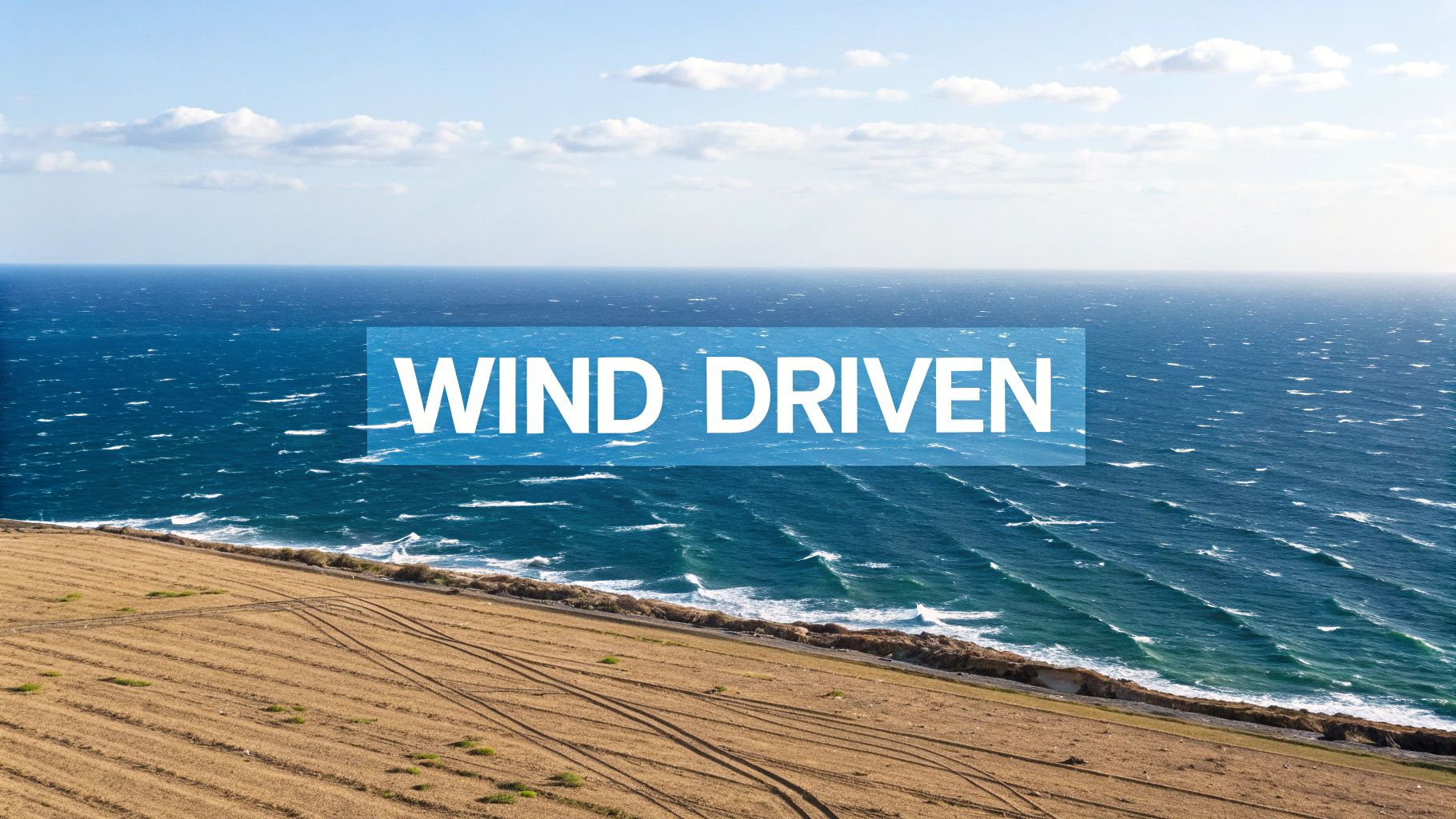
Of all the forces that make the ocean move, wind is the easiest one to wrap your head around. Think about blowing across the top of a hot cup of coffee—you instantly create ripples and get things swirling.
Now, imagine that on a global scale. Massive, relentless winds push against the ocean’s surface, not just for a moment, but day in and day out, all year long. This constant friction, this transfer of energy from the air to the water, is the main engine driving the surface currents you’ll feel in the water.
This isn’t just a random push, either. We’re talking about predictable, planetary wind patterns, like the famous trade winds that consistently blow from east to west near the equator. They literally drag the surface of the ocean along with them, setting in motion colossal amounts of water that form the backbone of the ocean’s circulatory system.
The Gulf Stream: Our Local Powerhouse
Right here in Florida, we have a world-class example of a wind-driven current on our doorstep: the Gulf Stream. It’s a key player in the massive circulation system of the Atlantic, acting like a giant, warm river flowing right through the ocean.
This current has a huge impact on life in the Keys. It hauls warm tropical water up the coast, which influences everything from our daily weather to the incredible variety of marine life you see on the reef. For us snorkelers, it means warmer, more comfortable water and a constant supply of nutrients that keep our coral ecosystems thriving.
Knowing how the winds shift with the seasons is key to predicting water conditions, which is why checking the Florida Keys weather by month is always a smart move before you plan your trip.
Global Gyres and Snorkeling Safety
So what happens when these powerful, wind-driven currents run into a continent? They don’t just stop. They get deflected and, with a little help from the Earth's spin, they bend into enormous circular patterns called gyres. There are five of these massive gyres in our oceans, and they act like continent-sized whirlpools, slowly churning the planet’s surface water.
The big picture is that global wind patterns, especially the trade winds and westerlies, are a primary cause of ocean currents. They push water into motion, creating giants like the Gulf Stream, which can move at speeds up to 2 meters per second. This current alone plays a huge role in regulating the climate of the entire East Coast.
Bringing it back to your snorkel trip, local winds are one of the most important things to consider. A strong wind whips up the surface, creating choppy conditions that can make swimming a real chore. More importantly, it can create localized currents that can push you around and tire you out quickly.
That's why one of the first rules of snorkeling safety is to always, always check the wind forecast before you even think about getting in the water. Knowing the wind's speed and direction is the first step to making sure your day is fun, relaxing, and safe.
The Great Ocean Conveyor Belt
While powerful winds are busy churning the ocean's surface, a much slower, deeper circulation is happening far below. This is the thermohaline circulation, a massive global current system often called the "Great Ocean Conveyor Belt." It’s the planet's ultimate slow-moving river, driven not by wind, but by fundamental differences in the water itself.
Think of it like a cosmic lava lamp. In a lava lamp, heated wax at the bottom becomes less dense and rises, then cools at the top, becomes denser, and sinks back down. The ocean operates on a similar principle, but instead of just heat, it uses two key ingredients: temperature (thermo) and salt content (haline).
Together, these factors determine the water's density. The rule is simple: cold, salty water is denser and heavier than warm, fresh water. Just like the cooling wax in the lava lamp, this dense water inevitably sinks, kicking off a colossal, globe-spanning journey.
The Engine of the Deep Ocean
This whole process kicks off in the frigid polar regions, particularly in the North Atlantic. As warm surface water travels poleward, it runs into brutally cold air. This chilling effect makes the water molecules huddle closer together, cranking up its density. But that's only half the equation.
As sea ice forms, it actually pushes the salt out, leaving the remaining unfrozen water even saltier and, therefore, even denser. This super-cold, super-salty water becomes so heavy that it just can't stay at the surface anymore. It begins to sink, plunging thousands of feet into the deep ocean and starting a slow, powerful flow away from the poles.
This simple yet powerful process is what drives thermohaline circulation.
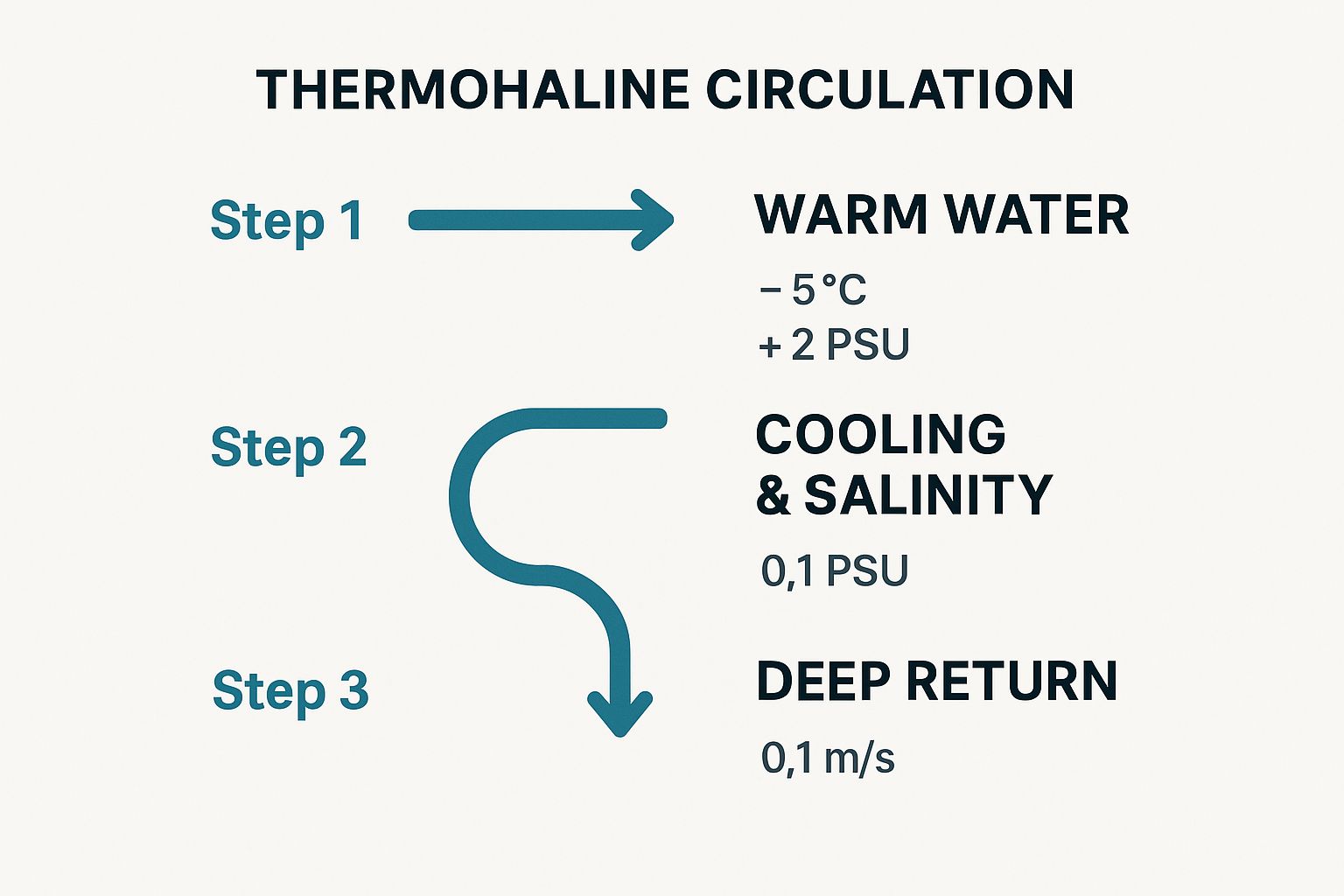
As the infographic shows, it’s the combination of decreasing temperature and increasing salinity at the poles that creates the dense water needed to drive this deep-ocean current system.
A Thousand-Year Journey
Once this water sinks, it embarks on an incredible, centuries-long trip along the ocean floor. This deep, cold current creeps through the Atlantic, into the Indian and Pacific Oceans, slowly mixing and warming along the way. Eventually, it will rise back to the surface—a process called upwelling—to begin the cycle all over again.
This entire circulation is a major cause of ocean currents, moving an astonishing 27 million cubic meters of water per second. That’s roughly equivalent to 100 times the flow of all the world's rivers combined, all happening in the silent darkness of the deep sea.
This conveyor belt is absolutely vital for regulating the global climate. It transports enormous amounts of heat from the equator toward the poles, balancing the planet's temperature. It also carries oxygen down to the deep sea and cycles nutrients that are essential for marine life. Even subtle shifts can have big effects, which you can see in our guide to the ocean temperature in Marathon, FL.
The formation of North Atlantic Deep Water near Greenland is a perfect real-world example of this system in action. Surface water cools, gets saltier, and sinks to depths of 2-4 kilometers. From there, it spreads southward, connecting all major ocean basins in a journey that can take centuries to complete.
How Earth's Spin Shapes Ocean Currents
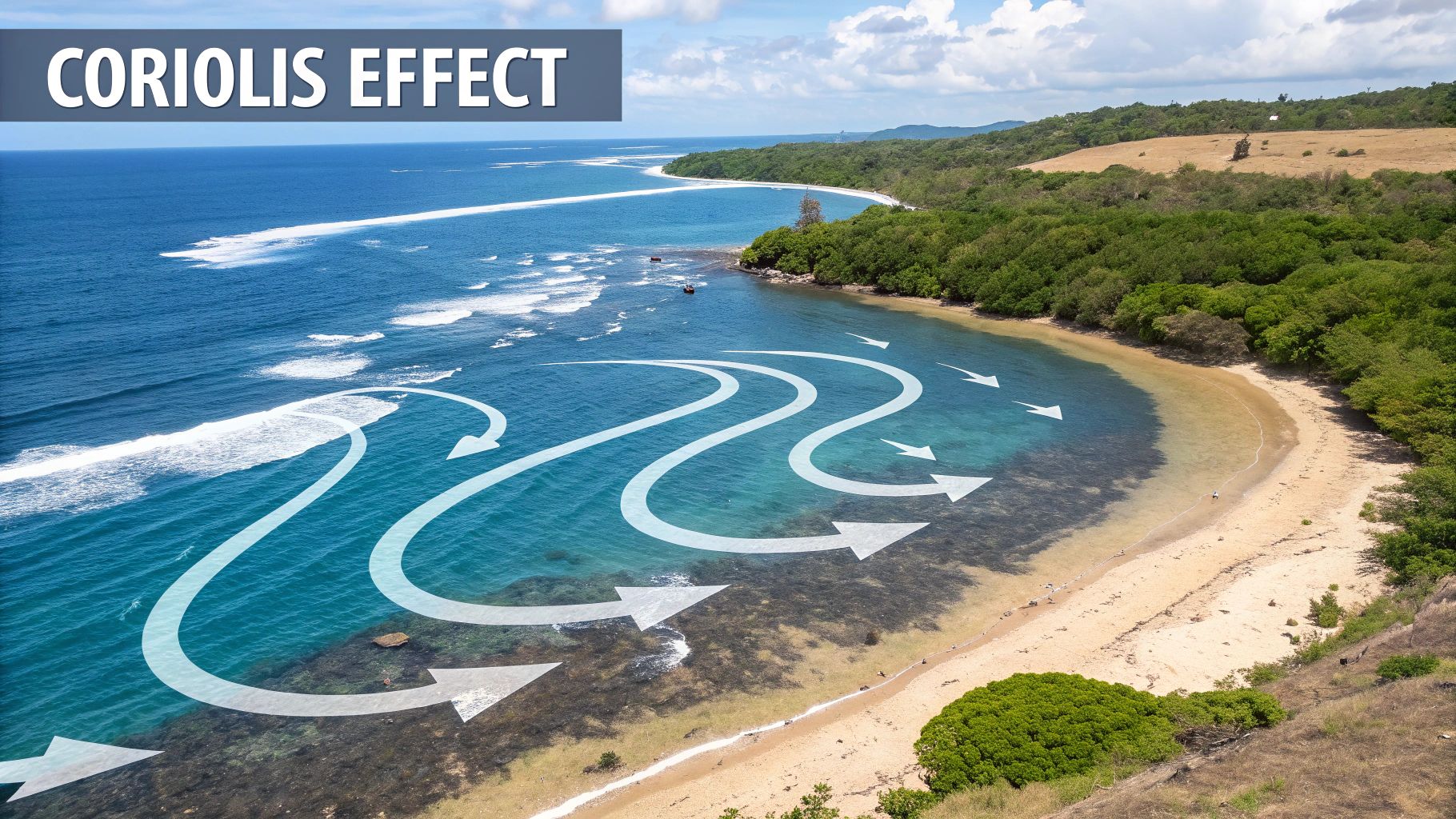
So if wind is the engine, constantly pushing the ocean's surface, why don't currents just move in perfectly straight lines? The answer is one of the coolest, most mind-bending forces on our planet, and it's all because our world is constantly spinning.
This spin creates an invisible but incredibly powerful phenomenon called the Coriolis effect. It can be a little tricky to wrap your head around, but a simple analogy makes it click. Picture yourself on a spinning merry-go-round, trying to roll a ball straight across to a friend.
No matter how straight your aim is, the ball will always seem to curve away from your friend. The ball isn't actually curving—it's because your target has moved by the time the ball gets there. The Earth's rotation does the exact same thing to anything moving over vast distances, from wind to ocean currents.
A Planetary Game of Deflection
At its core, the Coriolis effect is what makes ocean currents bend and swirl instead of flowing like a river from point A to point B. This planetary-scale curveball follows a simple, consistent pattern that’s absolutely critical for global circulation.
- In the Northern Hemisphere, moving water (and air) gets deflected to the right.
- In the Southern Hemisphere, it’s pushed to the left.
This is the secret ingredient that turns the straight-line push from the wind into the enormous, circular patterns we see on a world map.
The Coriolis effect is the reason wind-driven surface currents organize into huge, rotating systems called gyres. Without the Earth's constant spin, these massive, continent-sized whirlpools simply wouldn't exist, and the ocean would be a completely different place.
This force doesn't create the current—the wind handles that part. But it absolutely dictates the path that current will take on its long journey across the ocean basin.
For us snorkelers down in the Florida Keys, this global phenomenon has a very real, local impact. The Coriolis effect is a huge reason why the Gulf Stream, the powerhouse current in our backyard, hugs the coast and charges northward in a defined, curved path. It’s a pretty cool reminder that even the gentle current you feel on the reef is connected to the grand, spinning mechanics of our entire planet.
How Local Tides and Topography Steer Currents
While massive global forces choreograph the ocean's grand ballet, the currents you actually feel while snorkeling are often directed by a much more local conductor. The daily rhythm of the tides and the very shape of the seafloor play a huge role in what you experience in the water.
Think of the tides as the ocean’s slow, deep breath, driven by the gravitational pull of the moon and sun. This vertical rise and fall of sea level is what creates tidal currents—the horizontal flow of water rushing in to fill a basin (flood tide) or draining out (ebb tide).
Out in the open ocean, you might barely notice them. But here in the Florida Keys, where water gets funneled through narrow channels between islands, the effect is magnified. These natural bottlenecks can transform a lazy flow into a surprisingly swift current, which is why checking the tide charts is non-negotiable before a snorkel trip.
The Seafloor as an Underwater Obstacle Course
Beyond the tides, the physical shape of the ocean floor—its topography—acts like an underwater landscape of mountains, valleys, and plains that steer and shape the water's flow. A current that was moving steadily across a wide, flat bottom will behave completely differently the moment it runs into an obstacle.
It’s just like a river flowing smoothly until it hits a patch of big boulders. The water is forced to speed up and squeeze through the gaps, creating faster channels and calm eddies behind the rocks. The exact same thing happens in the ocean.
The seafloor is not a flat, featureless plain. Reefs, sandbars, and underwater canyons all act as barriers that redirect, accelerate, or slow down water flow, creating the complex micro-currents snorkelers experience every day.
This constant interaction between currents and topography creates an incredibly diverse and dynamic underwater environment. A current flowing over a shallow reef might speed up, bringing a steady supply of nutrients to the coral. Just on the other side of that same reef—the leeward (down-current) side—the water could be calm and protected, offering the perfect refuge for more delicate marine life.
How Topography Affects Your Snorkel Trip
Getting a feel for this concept can seriously upgrade your snorkeling experience. Knowing how the local features influence currents helps you find the absolute best conditions every time you get in the water.
- Reefs and Channels: Water speeds up as it flows over or through gaps in a reef. Snorkeling on the upstream side might feel like a workout, while the downstream side offers a calm oasis.
- Sandbars: These submerged hills of sand create their own unique flow patterns. You might find a gentle current on one side and perfectly still water on the other, which is a huge part of the appeal of exploring the famous Florida Keys sandbars.
- Water Clarity: Faster currents can stir up sand and sediment from the bottom, reducing visibility. Slower-moving water, on the other hand, allows all those particles to settle, leaving you with crystal-clear conditions.
By paying attention to both the tide schedule and the underwater landscape, you can start to predict where the calmest, clearest water will be. It’s the key to making sure your next snorkel is both safe and absolutely spectacular.
Reading the Water in the Florida Keys
So, how does all this science—the complex dance of wind, density, and Earth’s spin—actually help you on your snorkeling adventure? Simple. When you arrive at a reef in the Florida Keys, all these global forces have combined to create the specific conditions you’ll experience that day. That gentle push you feel in the water is the final, tangible result of an immense planetary engine at work.
This practical knowledge completely changes how you approach the water. A strong offshore wind might be a dead giveaway that a surface current is trying to push you away from the boat. A recent cold snap? That could hint at denser water, which might affect visibility and even how the fish are behaving. Our guide to the Florida Keys water temperature can help you connect these dots before you even get your feet wet.
Turning Knowledge into Action
Before every trip, your best bet is to translate this big-picture understanding into a simple pre-snorkel checklist. It’s a habit that builds confidence and ensures you’re always prepared for whatever the ocean has in store.
- Check the Wind Forecast: Don't just glance at it. Note both the speed and the direction. Wind is one of the biggest drivers of the surface currents and chop you'll be swimming in.
- Consult the Tide Charts: Tides create powerful, localized flows, especially when water funnels through channels between the islands. Knowing if the tide is coming in or going out tells you exactly which way the water will be moving.
Beyond just the science, developing a good eye for conditions is a skill every water enthusiast should have. Learning things like how to check ocean conditions for Big Island Hawaii offers valuable insights that apply anywhere, teaching you to observe and interpret the water's story no matter where you are.
When you put it all together, you can actually use currents to your advantage. A gentle current can carry you effortlessly along a reef, letting you cover more ground and see more marine life while conserving your energy. It’s like a natural, underwater moving walkway.
Armed with a solid grasp of what drives ocean currents, you're no longer just a visitor floating on the surface—you're an informed observer. You're ready to read the water, anticipate its movements, and safely immerse yourself in the incredible underwater world of the Florida Keys.
Frequently Asked Questions About Ocean Currents
Even after wrapping your head around what gets the ocean moving, a few questions always seem to surface. Getting these sorted out will make you a much more confident and savvy snorkeler, ready to hit the beautiful waters of the Florida Keys.
What Is The Difference Between A Current And A Tide
It’s incredibly easy to mix these two up, but they're driven by completely different forces.
A tide is the vertical rise and fall of the sea level. It’s all about the gravitational pull from the moon and the sun. The easiest way to think about it is like the ocean taking a very slow, deep breath in and out twice a day.
A current, on the other hand, is the horizontal movement of water—the rivers within the ocean. While tides can create their own flows (we call these tidal currents), the big ocean currents are mostly driven by other forces like wind and differences in water density.
How Fast Do Ocean Currents Move
The speed of ocean currents is all over the map. Way down deep, the great ocean "conveyor belt" might just creep along at a few centimeters per second. It’s a slow-motion giant.
But up on the surface, powerful currents like the Gulf Stream can really book it, traveling up to 2 meters per second (that's about 4.5 mph!). The local currents you'll feel while snorkeling are usually much slower, but they can still pack a surprising punch, especially when flowing through channels between the Keys.
Can You See Ocean Currents
You can't exactly see the water itself moving when you're out in the open ocean, but you can absolutely see its effects once you know what to look for.
A great trick is to watch for floating stuff, like seaweed or debris. If you see it all moving in a steady line, that's your current. You can also get a feel for its speed and direction by watching how the water flows around something stationary, like a channel marker or a buoy.
Ready to see these incredible natural forces for yourself? At Snorkeling Marathon And Sunset Cruise, our expert crew knows these waters like the back of their hand. We'll guide you through the stunning reefs of the Florida Keys, making sure your adventure is both safe and unforgettable. Book your trip today!