
Pigeon Key History The Island That Built the Overseas Railroad

The story of Pigeon Key is really the story of an impossible dream. This tiny five-acre island became the beating heart of one of America's most audacious construction projects: the Florida East Coast Railway's Key West Extension. Its entire existence boils down to the sheer challenge of building a railroad over miles of open ocean.
An Island Born From Steel and Sweat
Before the early 1900s, Pigeon Key was just another dot on the map—an uninhabited speck of land in the Florida Keys. But its location, smack in the middle of the seven-mile-wide Moser Channel, made it priceless to industrialist Henry Flagler and his wild vision of an "Overseas Railroad" connecting mainland Florida to the deep-water port of Key West.
Flagler’s dream hinged on building what would become the railway's crown jewel: the Seven Mile Bridge. You can't just build something that massive over open water without a base of operations right in the thick of it. Pigeon Key was the perfect spot. Almost overnight, it was transformed from a quiet, isolated islet into a gritty, bustling industrial camp built for one purpose and one purpose only.
A Hub of Industry Emerges
The island quickly became the headquarters for the massive bridge project. It was a self-contained world, designed from the ground up to support the hundreds of men who would spend years toiling under the relentless Florida sun.
- Housing the Workforce: Simple bunkhouses were thrown up to house the engineers, craftsmen, and laborers.
- Essential Services: A communal mess hall kept everyone fed, while other buildings supplied the tools and materials for the grueling daily work.
- Strategic Command: Engineers used the island as their command post, managing the mind-boggling logistics of building the bridge piece by agonizing piece.
Pigeon Key wasn’t chosen for its charm; it was chosen for its utility. It was an essential gear in the massive machine that built the Overseas Railroad—a testament to pure, unadulterated function.
The timeline below paints a clear picture of the island's incredible transformation from its rough-and-tumble beginnings to its role today.
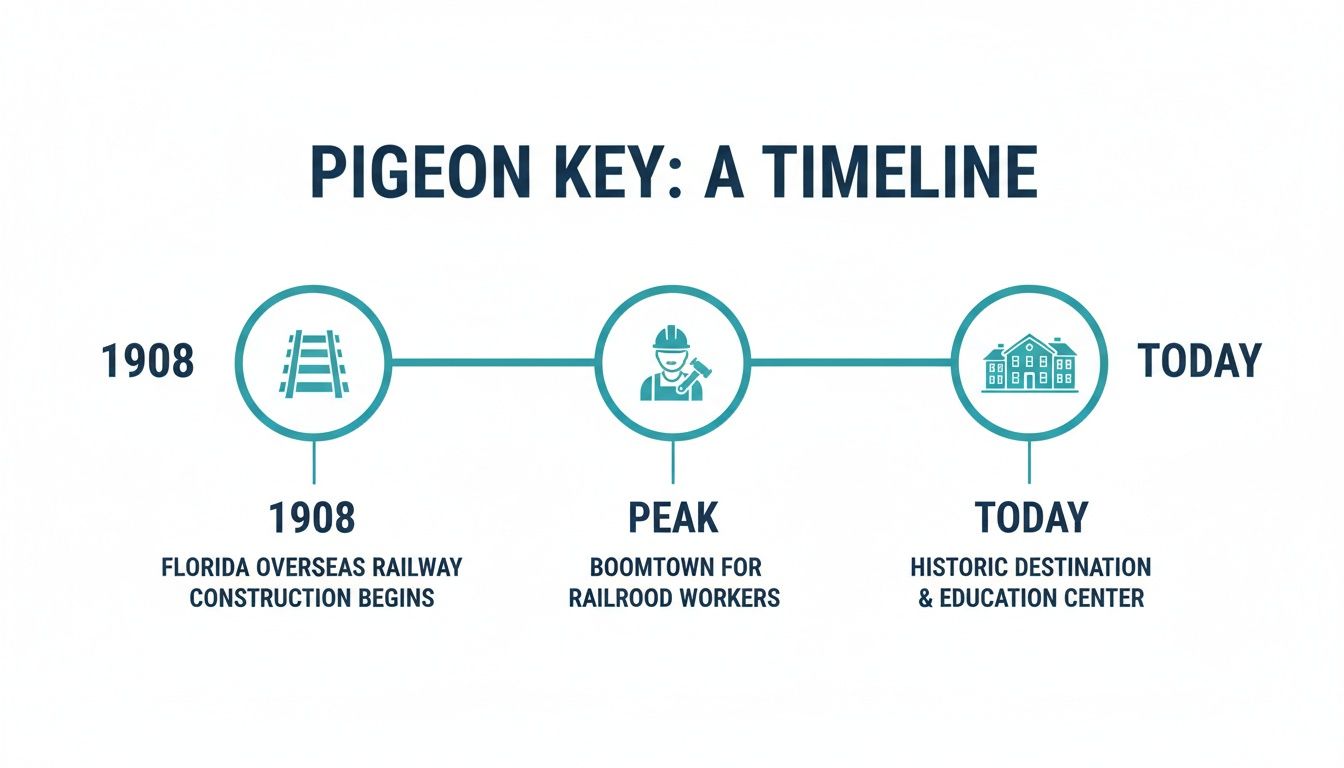
This visual journey shows how a temporary work camp, thrown together in 1908, quickly became a permanent and vital piece of Florida's history.
At its peak, this tiny island was home to roughly 400 workers. Even though it's only five acres, its historical significance is immense, with many of its original buildings now proudly listed on the National Register of Historic Places. You can dig deeper into its official historic designation over on the Monroe County website.
Life on the Line: Forging a Bridge and a Community
Between 1908 and 1912, Pigeon Key was much more than just a construction site—it was a world unto itself, buzzing with the relentless energy of human effort. We often see the story of the Seven Mile Bridge told through engineering diagrams and tons of steel. But the real history of Pigeon Key was written in the sweat and sheer grit of the men who lived there, forging a tight-knit community in one of the most demanding environments imaginable.
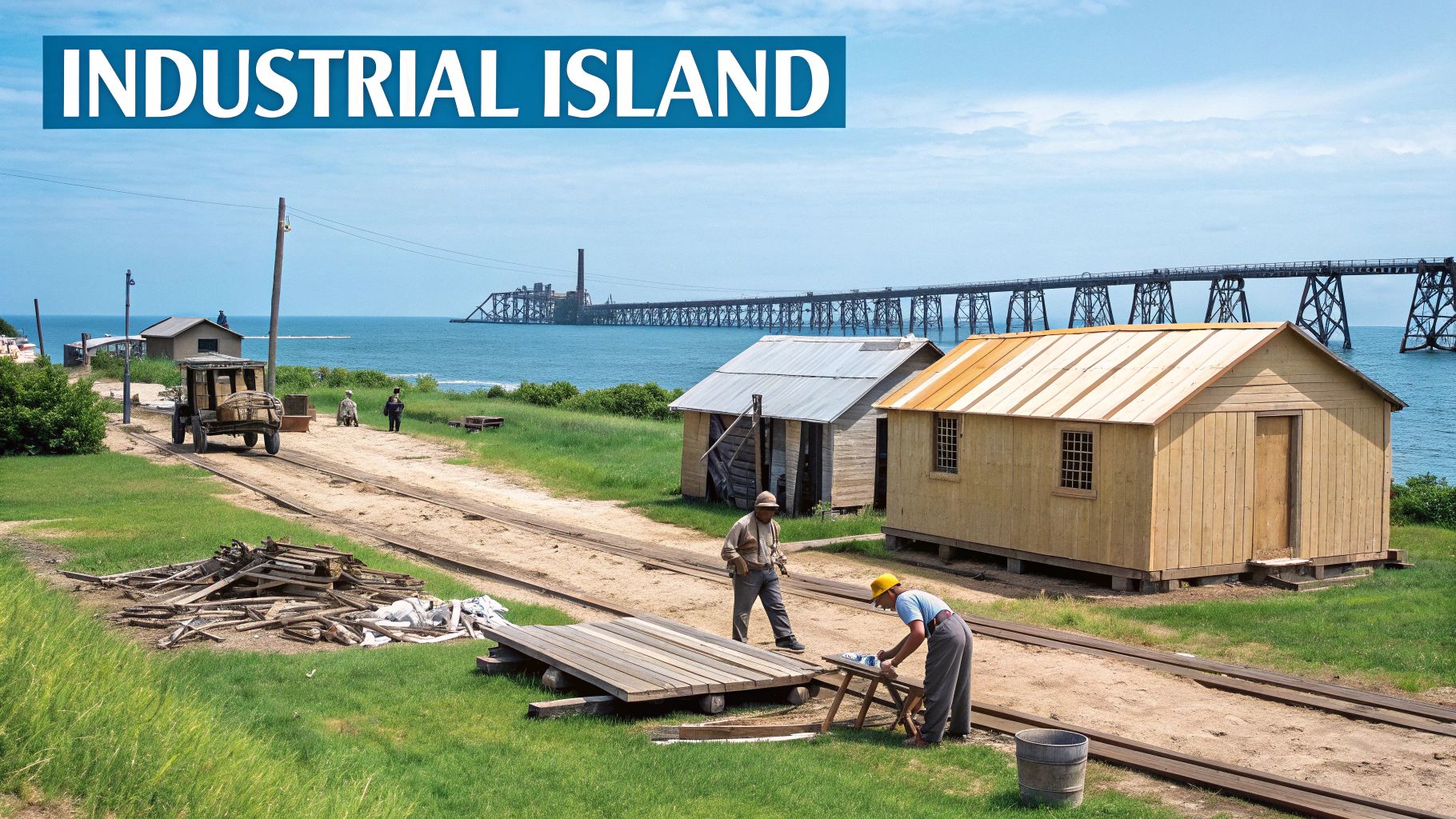
For the nearly 400 workers, daily life was a grueling cycle under the blazing Florida sun. This crew was a diverse mix of skilled engineers, tough-as-nails laborers, and specialized craftsmen, all facing conditions that would test anyone's limits.
The work wasn't just physically draining; it was incredibly dangerous. Men toiled high above the open ocean, wrestling with heavy materials and operating massive machinery with none of the safety gear we'd expect today. It was a high-stakes job, day in and day out.
Building a Community Against the Odds
Even with the isolation and tough conditions, a unique society started to form on this tiny five-acre island. The shared struggle and close quarters naturally built a powerful sense of camaraderie. This makeshift town became the human engine that powered the entire monumental project.
Life on Pigeon Key was structured and communal, revolving around a handful of essential buildings:
- Crowded Bunkhouses: These were simple wooden shelters, offering little more than a place to crash after an exhausting day. Privacy was non-existent, but they fostered a close-knit bond among the men.
- The Mess Hall: This was the social heart of the camp. More than just a place for a meal, it's where men from all different backgrounds would share stories, play cards, and find a brief escape from the grind.
- Support Buildings: A collection of workshops, tool sheds, and administrative offices kept the gears of the project turning smoothly, day after day.
This little outpost was a true microcosm of early 20th-century America. Workers flocked from all over the country—and even from overseas—lured by the promise of steady pay and a chance to be part of something legendary. This melting pot of cultures and experiences created a remarkably dynamic and resilient workforce.
For the men on Pigeon Key, the island was their entire world. They weren't just building a bridge; they were building a temporary civilization, bound together by a common, audacious goal.
Facing Down the Elements
Beyond the treacherous work, Mother Nature was a constant adversary. The workers had to endure blistering heat, thick swarms of mosquitoes, and the ever-present threat of tropical storms and hurricanes. Their isolation meant medical help was a long way off, and supply lines could easily be cut by a sudden storm.
This constant battle is a key chapter in Pigeon Key's history, underscoring the incredible perseverance it took to complete the Overseas Railroad. While all this was happening, the nearby town of Marathon was also starting to grow, offering a different view of life in the Keys during that transformative era. Checking out the other things to do in Marathon, FL provides great context for just how much the region was changing. The community forged on this tiny island remains a powerful tribute to the human spirit's ability to create connection and order, even in the face of impossible challenges.
From Railroad Camp to Island Neighborhood
Once the final spike was driven in 1912 and Henry Flagler's Overseas Railroad was officially complete, the thunderous noise of construction on Pigeon Key finally faded. The island's story, however, was far from over. It simply shifted gears, transforming from a gritty, temporary work camp into a quiet, permanent maintenance village—a crucial little outpost for the families who kept the railroad running.
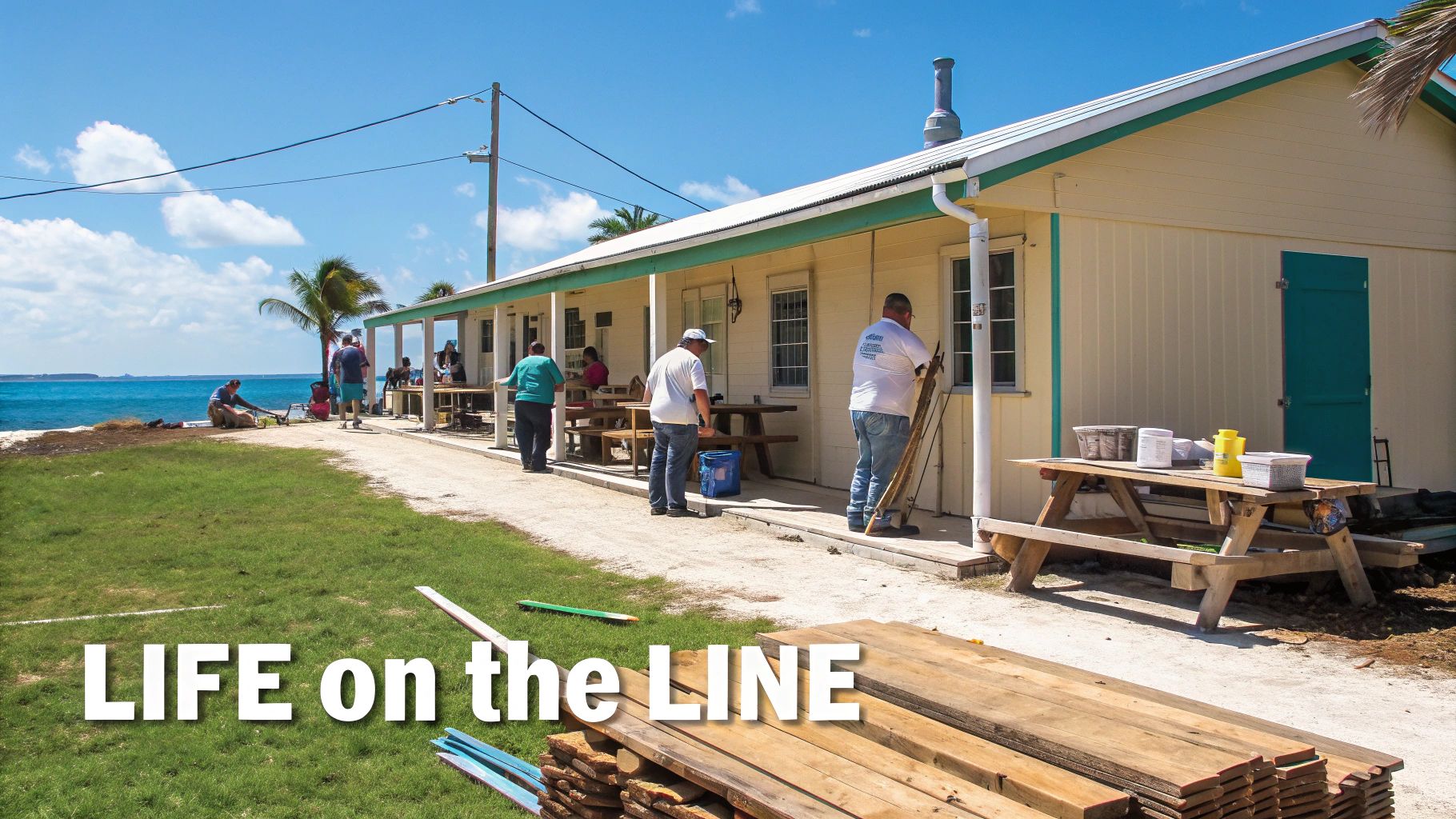
This new chapter in pigeon key history saw the island settle into a tight-knit community. The rough-and-tumble bunkhouses gave way to a more permanent neighborhood, now home to bridge tenders, section foremen, and their families. These residents were the unsung guardians of the Seven Mile Bridge, making sure this vital artery of American commerce stayed safe and operational.
A Self-Sufficient Island Community
Life on this tiny, isolated five-acre island demanded a special kind of resilience. As more families moved in, a unique social fabric began to weave itself together. The island wasn't just a workplace anymore; it was home, complete with the everyday rhythms of family life.
The transition from a boisterous camp of 400 men to a quiet village of a few dozen families marks one of the most significant shifts in Pigeon Key's identity. It became less about building a railroad and more about sustaining a lifeline.
To support this little community, new structures popped up that would have been unthinkable during the chaotic construction phase. These additions cemented Pigeon Key's new role as a genuine neighborhood, fostering a one-of-a-kind lifestyle for those who lived surrounded by the sea.
Life in the Village
Daily life was shaped by both the island's isolation and its core purpose: railroad maintenance. To make it work, the community developed its own essential amenities, creating a surprisingly complete little world.
- A One-Room Schoolhouse: A school was built in 1923 to educate the children of the railroad workers. This was a game-changer, making it possible for married personnel to bring their families and turning the island into a true community.
- A Local Post Office: With a permanent population, the island needed its own postal service to connect residents with the mainland and the wider world.
- The Bridge Tender's House: This building was more than just a home. It was the nerve center for monitoring the bridge's swing section, which opened to let boat traffic pass through.
This table really drives home the dramatic shifts in Pigeon Key's primary function and population size throughout its history.
Pigeon Key's Evolving Population and Purpose
| Historical Era | Primary Purpose | Estimated Population |
|---|---|---|
| 1908-1912 | Railroad Construction Camp | ~400 Workers |
| 1912-1935 | Railroad Maintenance Village | 40-50 Residents |
| 1992-Present | Historical Site & Education Center | Staff & Visitors |
This evolution from an industrial boomtown to a settled family community adds a rich, personal layer to the island's fascinating story, standing in stark contrast to its chaotic beginnings.
The Hurricane That Ended an Era
The quiet, workaday life on Pigeon Key—and the golden age of the Overseas Railroad—came to a sudden, violent end on September 2, 1935. A monstrous storm, later known as the Labor Day Hurricane, churned across the Atlantic and slammed into the Upper Keys with an unimaginable fury.
It was a catastrophic event that would reshape the Florida Keys forever.
This wasn't just any storm. It was one of the most intense hurricanes ever to make landfall in the United States, with winds estimated to have topped 200 miles per hour. This brutal force tore through the Upper Keys, obliterating everything in its path. For the Florida East Coast Railway, it was a death blow.
A Lifeline Severed
The storm’s impact was swift and devastating. It wiped out roughly 40 miles of railroad track, twisting steel rails like they were made of tin and washing away entire sections of the railway embankment. While Pigeon Key's sturdy buildings largely survived the storm's wrath, the island's lifeline—its entire reason for being—was severed in an instant.
The mighty Seven Mile Bridge, its faithful charge, was now a bridge to nowhere.
The destruction was so complete that the Florida East Coast Railway, already stretched thin by the Great Depression, was forced into bankruptcy. Rebuilding was simply not an option. With one storm, Henry Flagler’s grand "overseas" dream was over.
The Labor Day Hurricane didn't just destroy a railroad; it erased an entire era of Florida history. For Pigeon Key, the silence that followed the storm was the end of its life as a vital railroad community.
Paving a New Path
The human toll of the storm was immense. The hurricane killed an estimated 400–423 people, including around 250 World War I veterans who were working on local construction projects. In the aftermath, the state of Florida stepped in and purchased the Florida East Coast Railway's right-of-way, including the damaged bridges, for a mere $640,000. You can discover more about this historic storm and its consequences for the Keys in this Los Angeles Times article.
But this tragedy paved the way for the future. Engineers saw an opportunity. They realized they could repurpose the surviving railroad bridges to create something new: a continuous highway connecting the islands from top to bottom. This was the birth of the Overseas Highway, which would forever change the destiny of the Florida Keys and Pigeon Key along with it.
Understanding the region's climate is key to appreciating its history; our guide to the Florida Keys weather by month offers valuable insights into the powerful forces that have shaped this unique island chain. The age of the railroad was over, and the age of the automobile was about to begin.
Saving a Landmark From Neglect to National Treasure
When the 1935 hurricane ripped through the Keys and brought the Overseas Railroad to its knees, Pigeon Key's whole reason for being vanished almost overnight. The island, once a buzzing hub of industry and community, simply faded away. As the world moved on via the new Overseas Highway, the key was left behind, facing decades of neglect.
For a while, its historical weight was pretty much forgotten by the public. The island did find a new, quieter purpose, though. Starting in 1968, it became an environmental field station for the University of Miami. For about 20 years, students and researchers used the remote outpost to study the incredible marine ecosystems of the Florida Keys, keeping a light on when the island might have otherwise gone dark completely.
A Grassroots Preservation Movement
By the late 1980s, time was taking its toll. The historic wooden buildings were falling apart, and the island's legacy was on the brink of being lost forever. This threat lit a fire under local historians and community leaders who knew just how irreplaceable this piece of Florida’s industrial heritage was.
They didn’t see Pigeon Key as a forgotten relic; they saw it as a living museum—a tangible link to the sheer grit and determination that built modern Florida. Their goal wasn't just to patch up old buildings. They wanted to save the island's soul and share its incredible story with anyone who would listen.
This grassroots passion was the turning point in the modern pigeon key history.
The mission to save Pigeon Key was about honoring the human story behind the engineering marvel. It was a commitment to ensuring the voices of the workers who lived, toiled, and built a community here would not be forgotten.
Their hard work started paying off in a big way. The Pigeon Key Historic District was officially added to the National Register of Historic Places on March 16, 1990. Not long after, in 1992, the nonprofit Pigeon Key Foundation was formed to take charge of the island's restoration. You can dig into its official designations and history on sites like Wikipedia.
These efforts are a perfect example of what community-driven conservation looks like. By focusing on both preservation and education, the foundation really nails the core principles of responsible travel. You can get a better sense of this by exploring what is sustainable tourism and how it shapes special places like the Keys.
How to Experience Pigeon Key Today
After tracing its incredible journey from a rugged work camp to a treasured national landmark, the best way to truly appreciate the pigeon key history is to walk its grounds yourself. Visiting the island is like stepping through a portal to the past, giving you a direct connection to the grit and determination that built the Overseas Railroad.
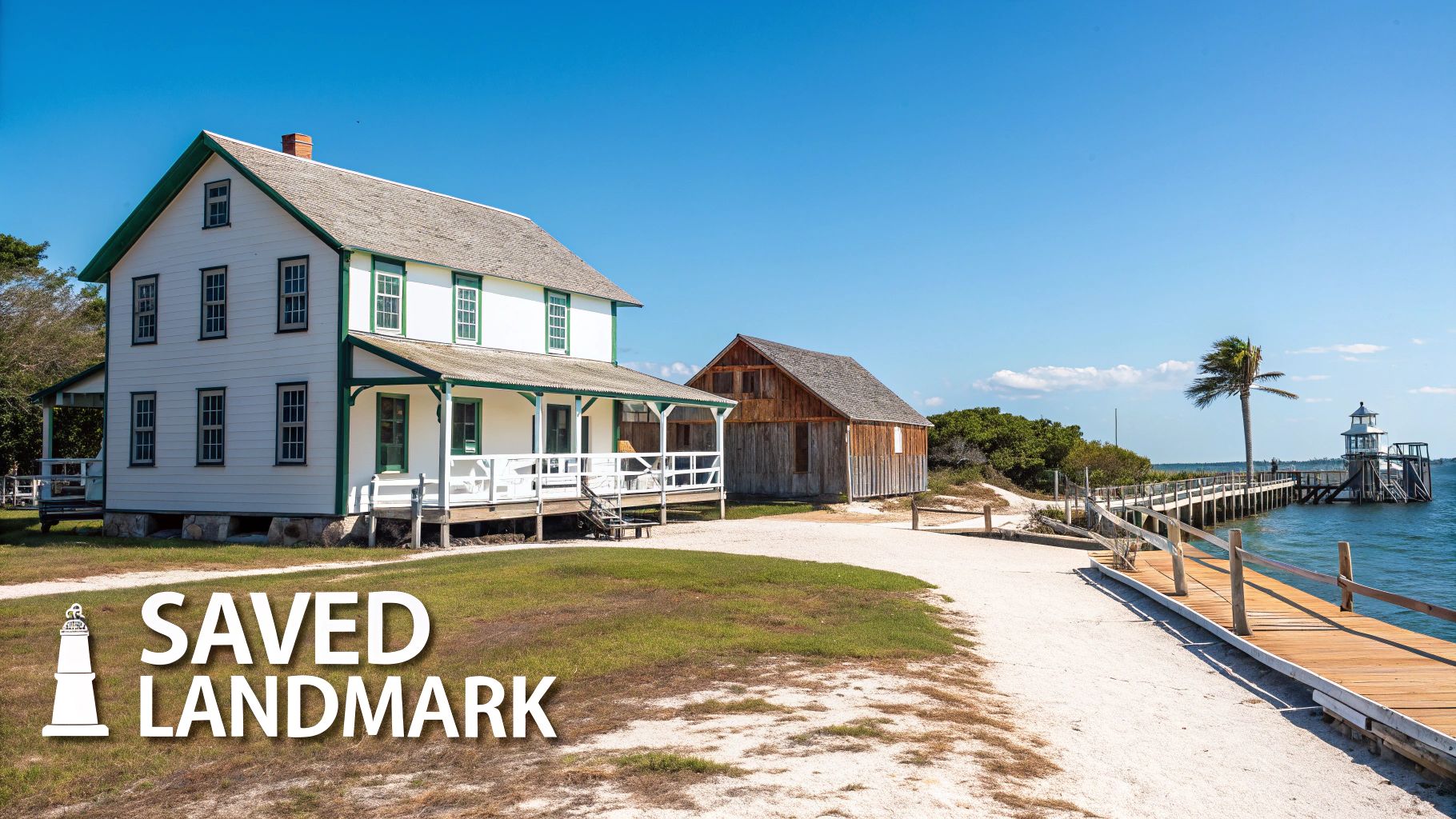
As you explore the five-acre island, you can wander through buildings that have stood for over a century, each one meticulously restored. Every structure whispers a piece of the island's story, letting you imagine the daily lives of the hundreds of workers who once called this tiny outpost home.
What to See on the Island
Taking a guided tour of Pigeon Key is the best way to bring the silent buildings to life with stories you'd otherwise never hear. You’ll get an up-close look at the island's most important historical structures.
- Restored Bunkhouses: Step inside the simple wooden quarters where railroad laborers lived. You'll get a real sense of the close-knit and demanding conditions they endured day in and day out.
- The Bridge Tender’s House: This building is now the island's museum, and it’s packed with fascinating artifacts, old photographs, and detailed exhibits that chronicle the island's incredible evolution.
- The Schoolhouse: See the one-room school where the children of the maintenance crew learned their lessons—a powerful testament to the community that thrived here long after the construction crews left.
For a truly unforgettable adventure that blends the island's rich past with the Keys' stunning natural beauty, our Pigeon Key History and Snorkel Tour is the perfect fit. It’s an exclusive trip that offers a unique way to connect with the story of the Keys, both above and below the water.
This isn't just another history lesson; it's a full-blown immersive experience. You get a fully guided tour of the historic island followed by a vibrant snorkeling session at a nearby reef, making it an ideal outing for families and history buffs alike.
This combination lets you first appreciate the human engineering that conquered the seas, and then dive right in to explore the incredible marine world that makes the Florida Keys so special. To learn more about this one-of-a-kind adventure, you can find all the details on our Pigeon Key Tour page.
Frequently Asked Questions About Pigeon Key
When you start digging into the history of Pigeon Key, a few common questions always pop up. Here are some quick answers to get you up to speed before you visit this one-of-a-kind Florida landmark.
Why Is It Called Pigeon Key?
Good question. The island got its name from the huge flocks of White-crowned Pigeons that used to roost there. Before Henry Flagler’s railroad construction kicked off in 1908, these birds were everywhere in the Keys.
Even after the bustling work camp displaced the original feathered residents, the name just stuck.
Can You Still Walk to Pigeon Key?
Unfortunately, no. The walkway to Pigeon Key, which is part of the iconic Old Seven Mile Bridge, is permanently closed off to all foot traffic. It’s a matter of safety, as that section of the bridge is no longer maintained for pedestrians.
These days, the only way onto the island is by boat. You can take the official ferry or join a guided tour that includes a stop there.
Access to Pigeon Key is exclusively by water. This preserves the island's historic atmosphere and ensures visitor safety, making the journey part of the overall experience.
How Long Did the Overseas Railroad Operate?
Flagler's incredible Overseas Railroad—officially known as the Key West Extension of the Florida East Coast Railway—had a surprisingly short run. It was in service for just over 23 years.
The railroad celebrated its grand opening on January 22, 1912, but its reign was cut short by the destructive Labor Day Hurricane of 1935, which wiped out huge sections of the track and brought operations to a permanent halt.
By the way, planning your trip around the weather is always a smart move in the Keys. Check out our guide on the best time to visit the Florida Keys to help you pick the perfect season for your adventure.
Ready to see this history for yourself? The Marathon Snorkeling And Sunset Cruise offers the premier tour that combines a fascinating look at the island's past with a beautiful snorkeling adventure. Book your trip at https://snorkelingmarathon.com.